
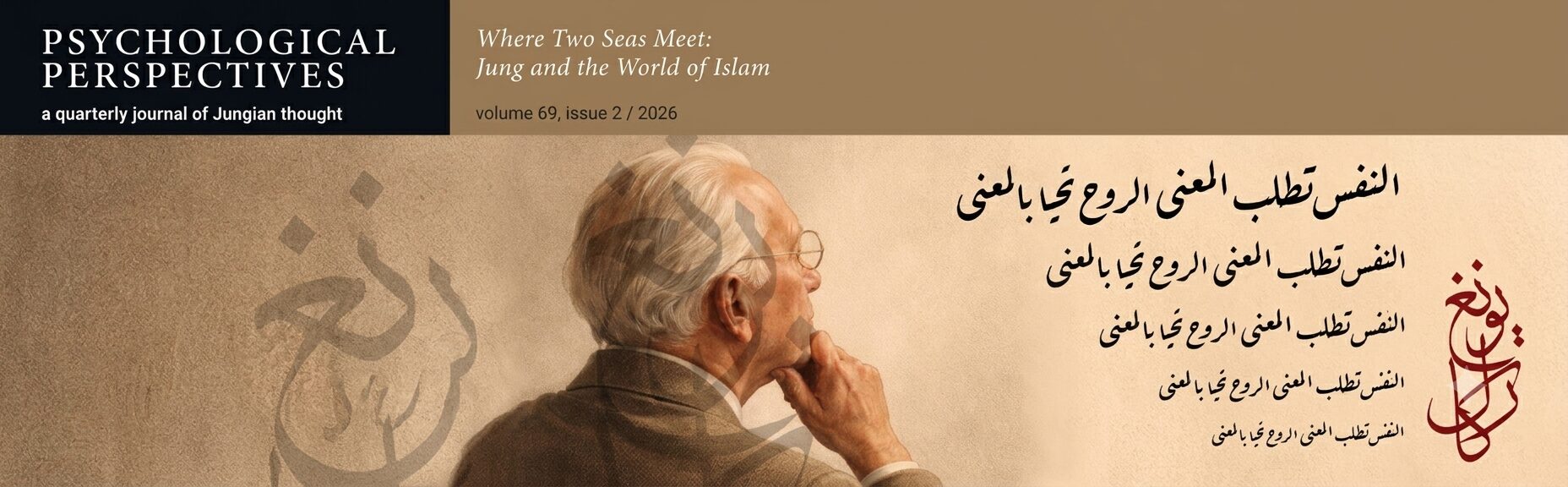
This special issue of Psychological Perspectives traces its origins to a 2023 online conference, “The Emergence of Soul: Jung and the Islamic World through Lecture and Art,” hosted by the International Association of Jungian Studies. Guest editor Frederick Burniston proposed expanding the conference papers into a full issue, and Christophe Le Mouël’s introduction credits a chain of connections, running from a 2009 conversation between Burniston and Ibn ‘Arabi scholar Samir Mahmoud through to contributors Daniela Boccassini, Rico Sneller, Jad Hatem, and Natalia Abdel Fattah, for bringing the issue into being.
Le Mouël’s introduction (open access) locates Jung’s own relationship to Islam in his travels. To the Maghreb in 1920, Africa in 1925–26, and India in 1937–38. He quotes Jung’s account of hearing a dying man’s cry of “Allah!” from a boat on the Nile, an experience Jung described as his first real understanding of “living Islam.” Le Mouël also draws on Marie-Louise von Franz’s research into Islamic alchemy, noting her argument that Islamic mystical alchemists, unlike their Hellenistic predecessors, brought an intense feeling-tone and poetic language to the coniunctio motif, reaching its fullest expression in Ibn ‘Arabi. The preface following the introduction is also open access.
Why Jung and Islam, and Why Now
D. Steven Nouriani’s opening perspective piece (open access) is candid about the gap the issue is trying to fill. Despite his sustained engagement with Christianity, Gnosticism, and Eastern religions, Jung’s direct contact with Islam remained comparatively thin, largely confined to his reading of the 18th Sura (“The Cave”) in his essay “Concerning Rebirth,” his acknowledgment of Arab alchemists like Jabir ibn Hayyan in Psychology and Alchemy, and passing references to Islamic mysticism. Nouriani attributes this partly to limited access to Islamic sources in early 20th-century Europe and partly to the fact that Jung’s travels, while extensive, never took him deeply into the Islamic world in the way they did India or East Africa. He frames the issue as an invitation for contemporary scholars to complete what he calls Jung’s “unfinished” psychology of religion, and closes his own piece with a summary of each contribution, most of which are detailed below.
Ibn ‘Arabi, Suhrawardī, and the Roots of Active Imagination
Several contributions cluster around Ibn ‘Arabi and Suhrawardī, the medieval mystics whose work has long drawn Jungian attention via Henry Corbin. Natalia Abdel Fattah’s “The ‘Muhammadi Light’: A Jungian Knot in Ibn ‘Arabi’s Poetry” reads the concept of al-nūr al-Muhammadī as both a Seal of Totality and a Seal of Individuation, tracing a three-part symbolic journey through the Abode, the driving force of love, and a final Great Voyage of shadow integration and ascent. Andrea Paula De Vita’s “The Intrepid Journey of the Unconscious: Suhrawardī’s Traces in Jung” argues that active imagination’s roots lie distinctively in Suhrawardī’s 12th-century concept of “knowledge by presence,” predating its more familiar transmission to Jung via Corbin. And Samir Mahmoud’s “Ibn ‘Arabi, Jung & the Origins of the Images of God” proposes a reciprocal rather than hierarchical relationship between the two thinkers, Ibn ‘Arabi extending Jung’s psychology into deeper metaphysical territory, and Jung in turn rendering Ibn ‘Arabi’s mysticism legible to modern audiences.
Khidr, Dreams, and Jung’s Own Encounters
Steven Herrmann’s “Jung’s Love for the Arab Prince: Khidr, the Green One” is among the issue’s more personal contributions, drawing on Jung’s 1920 dream of an Arab prince in Tunis and his 1922 active imagination dialogue with Khidr, recorded in Black Book 7, to argue that this encounter shaped Jung’s 1939 essay on the 18th Sura and his vision of a luminous green Christ. Frederick Burniston’s “Between the Ablution and the Sacrifice” takes a similarly biographical approach, examining Jung’s extended dream of his deceased father in Akbar’s Council Hall, using it to argue for a more sympathetic reading of Paul Jung than the one given in Memories, Dreams, Reflections, before tracing shared affinities between Jung, Meister Eckhart, and Ibn ‘Arabi on the question of God’s relativity.
Love, Synchronicity, and Clinical Practice
D. Steven Nouriani’s second contribution to the issue, “On the Meaning of Love in Sufism: Clinical Implications for Analytic Work,” examines a central Sufi hadith describing the universe as created from Divine love, and proposes that synchronicity in the analytic relationship may be understood as a resonance with the Mundus Imaginalis. Karin Jironet’s “An Envisioned Dialogue” takes a more experimental form, using active imagination itself as a structural device to stage an imagined conversation between Jung and Sufi mystic Hazrat Inayat Khan, who never met in life. Rasjid Skinner and Frederick Burniston’s “Introducing Islamic Psychology” surveys the contemporary field of Islamic psychology and asks whether Jung’s depth psychology belongs at its margins or its centre. And Jad Hatem’s “The Fish of Transmutation in the Sura of the Cave” offers a close critical reading of Jung’s own analysis of the 18th Sura, arguing Jung overlooked the possibility that the Sura is structured like a dream.
A Personal Essay, Poetry, and Reviews
Salma Ahmad Caller’s “Muhammad Ali Came to Tea — A Discordia Concors” stands apart as a personal essay, built around a torn and later reconstructed family photograph from a 1989 visit by Muhammad Ali to her father’s home in Riyadh, which she reads as an image of her own hybrid existence. The issue also includes poetry from Moustapha Abdelfatah and Narda Dalgleish, and closes with Steven Herrmann’s review of Reza Shah-Kazemi’s Paths to Transcendence According to Shankara, Ibn Arabi, and Meister Eckhart, alongside Frederick Burniston’s “Approaching Islam: A Mercifully Short Reading List” for readers wanting to go further.
You can see the full list of articles here.