
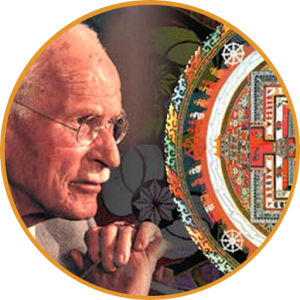
We will begin our 2022 Summer Study online program with an overview of C.G. Jung’s understanding of psycho-spiritual transformation with particular reference to his massive volume Symbols of Transformation. The following session will delve into the power of images to transform our lives and our world and to reveal the ever-deeper dimensions of the soul. Mid-week we will gain an understanding of the paradoxes of compulsion, moving our perception of it from that of a conscious burden to a transformative agent arising from the healing depths of the unconscious. Our Thursday session will examine the role of transgression in the work of Freud and Jung and consider its necessity in the enterprise of psychology to promote the transformation and actualization of the self. Our week concludes with an exploration of the part that transformation plays in individuation. We will look to metamorphoses in ancient mythology to illustrate both the positive and negative poles of this process.
Welcome and Orientation
Monday, July 11 | 9:30-10:00am
Transformation
10:00 am-12:00pm, 1:00-3:00pm
In the course of his career, Jung became deeply involved with the question of the psychological and spiritual transformation of his patients and the larger personal encounters with the human predicament among the peoples of the world and their stories of transformation. In this session we will explore Jung’s understanding of the archetype of psycho-spiritual transformation of persons, individually and collectively, especially as his thinking on this question is given to us in his book Symbols of Transformation (Jung, C.G., CW 5: Symbols of Transformation).
Instructor: Donald R. Ferrell, PhD, LP, STM, MDiv
LEARNING OBJECTIVES:
- Explore Jung’s conception of Libido as Psychic energy and the ways it manifests within the psychological, social and cultural life worlds of the ego to facilitate the transformation of ego consciousness toward a greater wholistic understanding of the Self and the world.
- Discuss the two primary forms of libido as Jung conceives them: i. e., instinctual libido and spiritual libido.
- Explain the role of Images and Symbols as transformers of libido and how transformation is related to the power and presence of these universal symbolic and imagistic forms from the collective unconscious.
- Describe their own transformative experiences and thereby learn from each other how transformation unfolds in our own lived experiences.

Images of Transformation
Tuesday, July 12
10:00 am-12:00pm, 1:00-3:00pm
“It is as if we did not know or else continuously forgot that everything we are
conscious of is an image and image is psyche.” C.G. Jung CW 13, p.50.“Gestaltung, Umgestaltung, Des ewigen Sinnes ewige Unterhaltung”
Formation, transformation, Eternal Mind’s eternal recreation.
Wolfgang Goethe, Faust II, Act1, Scene 5 (quoted by C.G. Jung in MDR, p.195)
Jung’s opus is a testimony to the power and importance of images for the human psyche and culture. For Jung, psyche consists essentially of images that “have a quality of consciousness.” Since his confrontation with the unconscious in the Black Books and The Red Book, Jung worked ceaselessly to develop psychology rooted in the soul. “The modern man search for the soul,” is essentially a quest to notice spontaneously emerging images, express and value them, and dialogue with and otherwise engage them. Informed and inspired by C.G. Jung’s , James Hillman’s and Gaston Bachelard’s understanding of the image, we will explore the power of images to transform our lives, our relationships, our worlds and the world. We will trace the vicissitudes of the image as it transforms itself, revealing ever-deeper dimensions of the soul. Emphasis will be given to fostering imaginal consciousness that is attuned to the archetypal background and development of analytical attitude towards transformative psychic processes. We will engage in the dialogues (as much as the mediating platform ZOOM allows) with poets, artists, psychologists and ourselves to deepen our understanding of images, psyche and transformation.
Instructor: Sylvester Wojtkowski, PhD
LEARNING OBJECTIVES:
-
- Identify psychic images and differentiate them from concepts and ideas.
- Understand and apply the technique of amplification to the psychic material.
- Discuss how to engage the images in dreams and fantasies.
- Describe the elements of the process of Active Imagination

Transforming Compulsion:
The Mystery of Unconscious Agency
Wednesday, July 13 | 10:00 am-12:00pm, 1:00-3:00pm
This day-long workshop will work with both clinical and personal material to re-imagine compulsive actions and ideas from within a Jungian framework. We will tease apart the difference between what is compelling in the sense of inspiring and how that can slide over into the compulsive in the sense of loss of agency and the question of fate. Historically, compulsions have been seen as signs of evil, as the lack of willpower, or as environmentally caused. In none of these explanations is the question of ‘what is it for’ ever asked. Jung writes in Mysterium:
Compulsion is the great mystery of human life. It is the thwarting of our conscious will and of our reason by an inflammable sulphuric element within us, appearing sometimes as a consuming fire and at others as life-giving warmth. The efficient and final cause of this lack of freedom lies in the unconscious and forms that part of the personality which still has to be added to the conscious person in order to make them whole. (Mysterium Coniunctionis 154)
From this radical point of view a compulsion is a complex paradoxical phenomenon which is related on one hand to agency, wholeness, and the warmth of desire, and yet it can consume us and drive us against our will into fruitless thoughts and actions. Understanding this paradox allows us to ask what this often-dark urge is bringing to consciousness – which in turn allows for a change in ourselves and in the urge itself. In our time together we will look at historical and personal examples of compulsion as well as the experiential limit of willpower and the source of ideas and motivation. We can then see how a compulsion might arise from the healing depths of the unconscious, even if it seems like a burden to our conscious standpoint. This will allow us to consider compulsion from another angle and press it for its telos; that is, we can find its specific goal – that is, it needs to add a critical factor to our consciousness. This effect transforms our personality and liberates us from the internal bonds that tie us to unchanging thoughts and actions and meaningless suffering.
Instructor: Morgan Stebbins, MDiv, LMSW, LCPsyA, DMin
LEARNING OBJECTIVES:
-
- Explain the difference between traditional and symbolic understanding of compulsion
- Discuss the paradoxical nature of compulsion and inspiration
- Recognize the idea that what arises against our will is itself an aspect of wholeness
- Apply a beginning facility with translation of literal compulsions into symbolic understanding

Transgression and Transformation:
Is Analysis a “Dangerous Method”?
Thursday, July 14 | 10:00 am-12:00pm, 1:00-3:00pm
In this seminar Sanford Drob will examine the place of “transgression” in the work of Freud and Jung. We will discuss, through an examination of Freud’s and Jung’s life and writings (particularly those in The Red Book), how the therapeutic and individuation process is transgressive in its very nature. Individuation will be understood as a creative enterprise, one in which the individual and therapist must both keep an “ethical frame” and yet transgress what had hitherto been acceptable (to the ego, society, etc.), go beyond what is known and routine, and enter new psychic territory. Further, we will consider the hypothesis that the very enterprise of psychology must itself be transgressive if it is not to become rigidified and irrelevant. For this reason, there can be no formula, theory or technique that one can learn that will by itself promote the transformation and actualization of the self or others. This is both the great promise and the clear danger of the path embarked upon by Freud and Jung.
Instructor: Sanford Drob, PhD
LEARNING OBJECTIVES:
- Summarize the role of transgression, both in the sense of “a violation of a law, duty or moral principle” and the “overstepping of or going beyond some boundary or limit,” for the origin, significance and practice of depth psychology as well as in cultural and personal transformation.
- Describe on how Jung’s transgressions in the Red Book, against the scientific and ethical ruling discourse, paved the way for his novel approach to psychology and analysis.
- Elaborate the relevance of the paradigm shift concept in the philosophy of science and genre change in the arts shed light on analytic theory and therapeutic change.
- Recognize that while “transgression” is written into the core of psychoanalysis and psychodynamic theory, and is a critical (perhaps “non-specific”) variable in psychotherapeutic treatment, not all psychotherapy begins with a transgression of boundaries—and that the treatment of a whole host of patients must first involve the shoring up of boundaries, both within the psyche, and between self and others.

Transformation, Redemption, and Individuation
Friday, July 15 | 10:00 am-12:00pm, 1:00-3:00pm
Transformation is defined simply as change in form, appearance, nature or character. Jung, however, seems exclusively to connect transformation to rebirth, a specific aspect of the individuation process in which something destructive becomes helpful. Jung found alchemy to be a metaphor for the work of transformation.
In mythology, transformations take many different forms. Zeus, for example, changes his form to win the love of a mortal: a swan for Leda, a bull for Europa. Hera avenges Zeus’ trysts with transformations of the love object: Io into a cow; Echo into a being without her own voice. Athena turns the beautiful Medusa into a hideous Gorgon. Daphne turns herself into a tree to avoid Apollo’s advances. In Ovid almost all transformations are punishments for incorrect attitudes or behaviors.
In this class, we will examine transformation from both the positive and negative poles to see its role in the individuation process.
Instructor: Julie Bondanza, PhD
LEARNING OBJECTIVES:
- Differentiate among transformation, redemption and individuation.
- Identify the behavior and/ or attitude that resulted in transformation
- Describe one example, either clinical, mythological or literary that results in a transformation, either positive or negative.
- Demonstrate how transformation effects the process of individuation.
