
The C.G. Jung Club London’s Grass Roots seminars return in September for their 2026–27 programme, offering a substantial introduction to the foundations of analytical psychology. Although hosted by the London Club, the seminars are entirely online via Zoom, making this long-established programme accessible well beyond London and the UK. Sessions take place on Wednesday evenings from 7–9pm, with advance booking required to receive the Zoom link.
The programme has an unusually long history. Grass Roots was established in 1973 by Faye Pye, then chairman of the Analytical Psychology Club, the organisation that subsequently became the C.G. Jung Club London. Pye conceived the seminars as a way of continually returning to the fundamental ideas of Jungian psychology. In her own description of the programme in 1979, Grass Roots I and II were intended to teach Jung’s “basic principles of the structure and dynamics of the psyche, and its cultural manifestations”.
More than fifty years later, that original conception remains clearly visible in the curriculum. Term 1, beginning on 23 September, moves from Martin Gledhill’s Jung and Bollingen – Constructing a Jungian Sense of Place through the structure of the psyche, George Bright’s introduction to Liber Novus: The Red Book, ego and Self, archetypes, shadow, complexes, and animus and anima.
Term 2, beginning in January 2027, extends the programme into psychological types, Jung and religion, myth and fairytales, dreams, active imagination, the collective unconscious and the ancestors, the symbolic attitude and alchemy, before concluding with individuation on 24 March. Taken together, the two terms offer a remarkably broad survey of the conceptual language that has developed around Jung’s work. The seminars are intended both for people encountering analytical psychology for the first time and for more experienced readers wishing to return to its foundations; they do not constitute a professional training or qualification in therapeutic practice.
The history of Grass Roots is inseparable from Faye Pye herself. After studying English at Cambridge and medicine at the Royal Free Hospital, Pye qualified as a doctor in 1944, worked in psychiatry and subsequently travelled to Zurich, where she became one of the early students at the C.G. Jung Institute. She knew Jung, analysed with Toni Wolff and trained alongside Vera von der Heydt.
Pye later spent many years practising in South Africa, working with African, Afrikaner and English-speaking analysands. Her writing from this period examined how culture, social division and the instability of the surrounding world enter psychological life — questions that gave her work a strikingly contextual quality for its time. After returning to London in the early 1960s, she became deeply involved in the Jung Club, serving two periods as chairman, establishing public lectures as well as Grass Roots, and publishing extensively in Harvest and the Journal of Analytical Psychology. She was also among the founding members of the Association of Jungian Analysts.
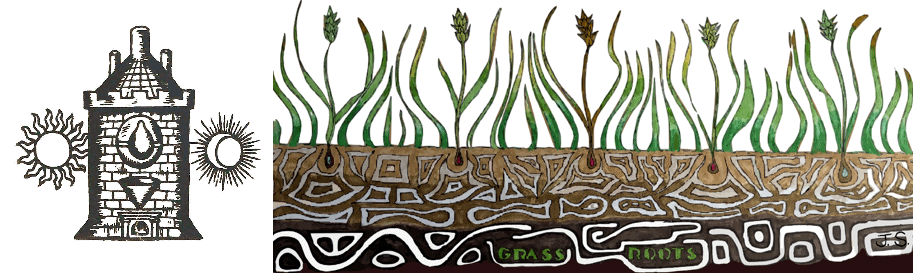
The name Grass Roots was itself part of Pye’s conception of what such a programme should do: prepare the ground, sow the seeds and allow roots to develop, strengthening the centre from which further psychological exploration could grow. It is an image of education not simply as acquiring information, but as repeatedly returning to first principles. More than half a century after Pye introduced the seminars, that remains their distinctive purpose.
Full details of the 2026–27 programme and booking for individual seminars are available on the C.G. Jung Club London website. Seminars cost £25 each and are free to Club members.