
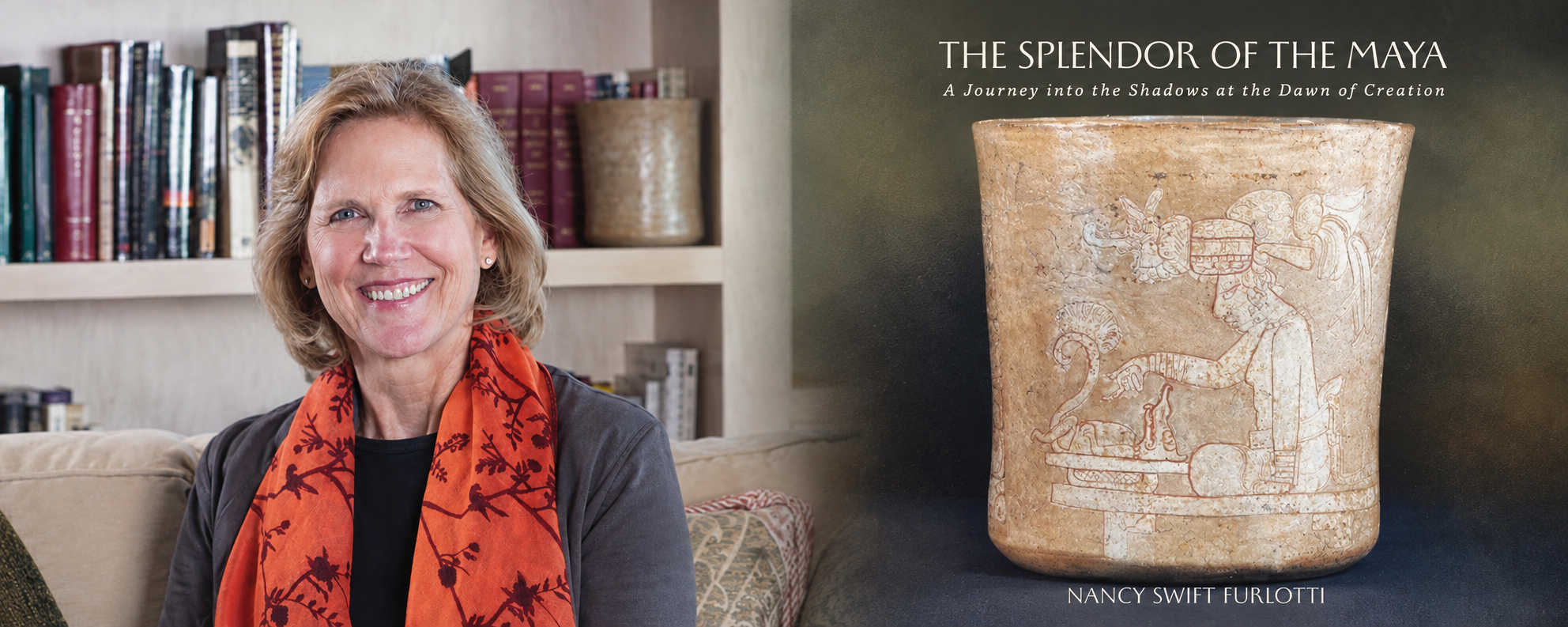
The creation myth of the K’iche’ Maya puts forth that the first people were made of mud, and then fell apart. The second were carved from wood, and they could talk but could not remember who made them. Only the third attempt, with people made from white and yellow maize, worked. Even then, the creators dimmed their sight so they would not become gods.
This is the story called the Popol Vuh, and it is the subject of a seminar tonight, Friday 9 October at the C.G. Jung Institute of Los Angeles, given by Nancy Furlotti. This talk celebrates the publishing of her new book The Splendor of the Maya: A Journey into the Shadows at the Dawn of Creation, by Texas A&M University Press in the Carolyn and Ernest Fay Series in Analytical Psychology.
The Popol Vuh as recorded as far back as 300 BCE, preserved in the sixteenth century, and still part of a living cultural tradition. Furlotti reads her interpretation as a story about what it means to become a person. Being fully human, in this tradition, means being relational and also a part of nature rather than above it. Failed creations and human limits, far from hindering wholeness, are part of being fully human. The seminar looks at how the myth portrays the emergence of consciousness, the limits of the ego, and life as cycles of transformation, with clinical examples throughout.
Furlotti is a Jungian analyst and past president of the C.G. Jung Institute of Los Angeles. She is also a founding member and past president of the Philemon Foundation, which published Jung’s Red Book. Her previous work includes The Dream and its Amplification; Eternal Echoes: Erich Neumann’s Timeless Relevance to Consciousness, Creativity, and Evil. Furlotti discusses the Popol Vuh and her work with the Philemon Foundation in an hour-long interview with Laura London on the Speaking of Jung podcast, recorded in 2021. You can watch it here.
The program runs from 7.30pm to 9.30pm on Zoom and in person at the Institute’s lecture room and will be recorded. Registered attendees can watch it for one month afterwards. To register, click here.