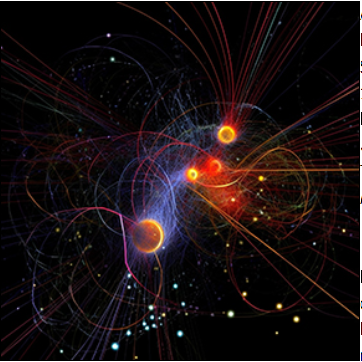
Let’s explore the fascinating overlap between contemporary physics and one of Jung’s most significant ideas, probing riddles as diverse as the fate of Schrödinger’s cat, whether there are hidden variables, and the nature of the collective unconscious.
In the opening paragraph of his 1952 essay on synchronicity, Jung writes that modern physics has shattered our worldview, replacing causal certainty by statistical truths. There is a need to posit other types of connection that are not part of the system of natural laws, to explain what we see around us. Jung proposed synchronicity as a principle of connection arising from psyche’s search for meaning. There are parallels to this psychological hypothesis in quantum physics. For a century, physicists have wrestled with the question of what makes the reality we perceive, given that quantum descriptions are indefinite. Spatially separated events may be correlated, without the possibility of causation. It turns out that at a microscopic level, objects are not separate but inextricably entwined, part of a Unus Mundus.