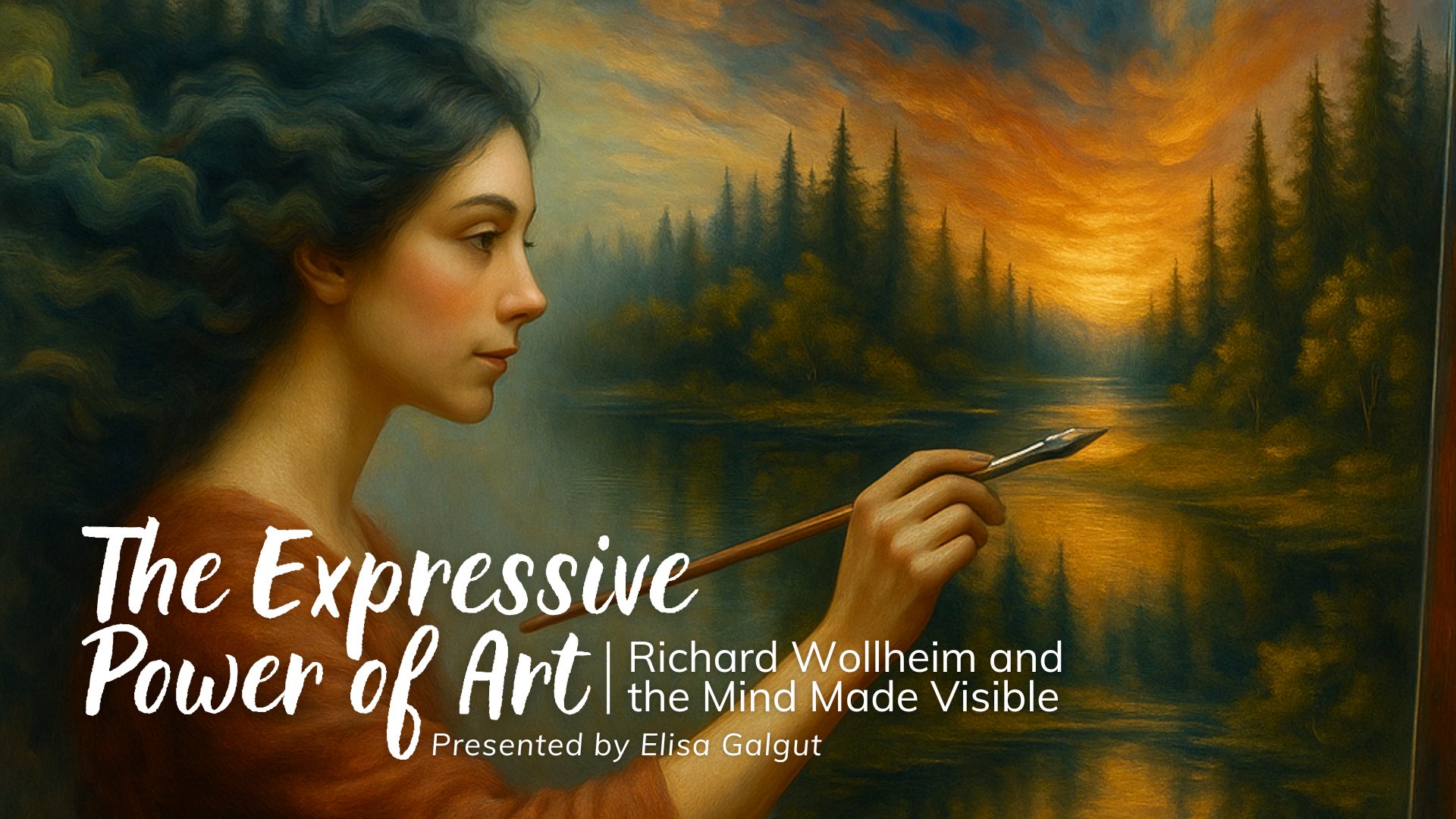
Works of art are expressive. Whether one sees this as an essential feature of all artworks, or as characteristic of only some, it seems uncontroversial that we are drawn to art because of its expressive power. Yet the source of this expressiveness is far from obvious.
After all, works of art do not have psychologies; they cannot literally experience or express emotions. And while we might describe a painting as “sad,” it does not follow that we ourselves feel sadness in its presence. The relation between the expressive qualities of art and our own emotional responses is therefore complex, and has long been a subject of philosophical debate.
In this presentation, Elisa Galgut explores how the philosopher Richard Wollheim approaches this puzzle. For Wollheim, the expressiveness of art lies not in the artwork’s capacity to display emotion directly, but in its correspondence to the artist’s internal state. A painting, in his view, is more than a representation of feeling. It is a manifestation of mental life itself, a transformation of inner experience into visible form.
Drawing together philosophy, psychology, and aesthetics, this talk examines how Wollheim’s ideas illuminate the ways in which art embodies mental life and transforms inner experience into visible form.
Join us for an aesthetic exploration with Elisa Galgut as she invites audiences to see paintings as living traces of the mind made manifest in the world, and to reflect on the mysterious link between the psyche and the image.