
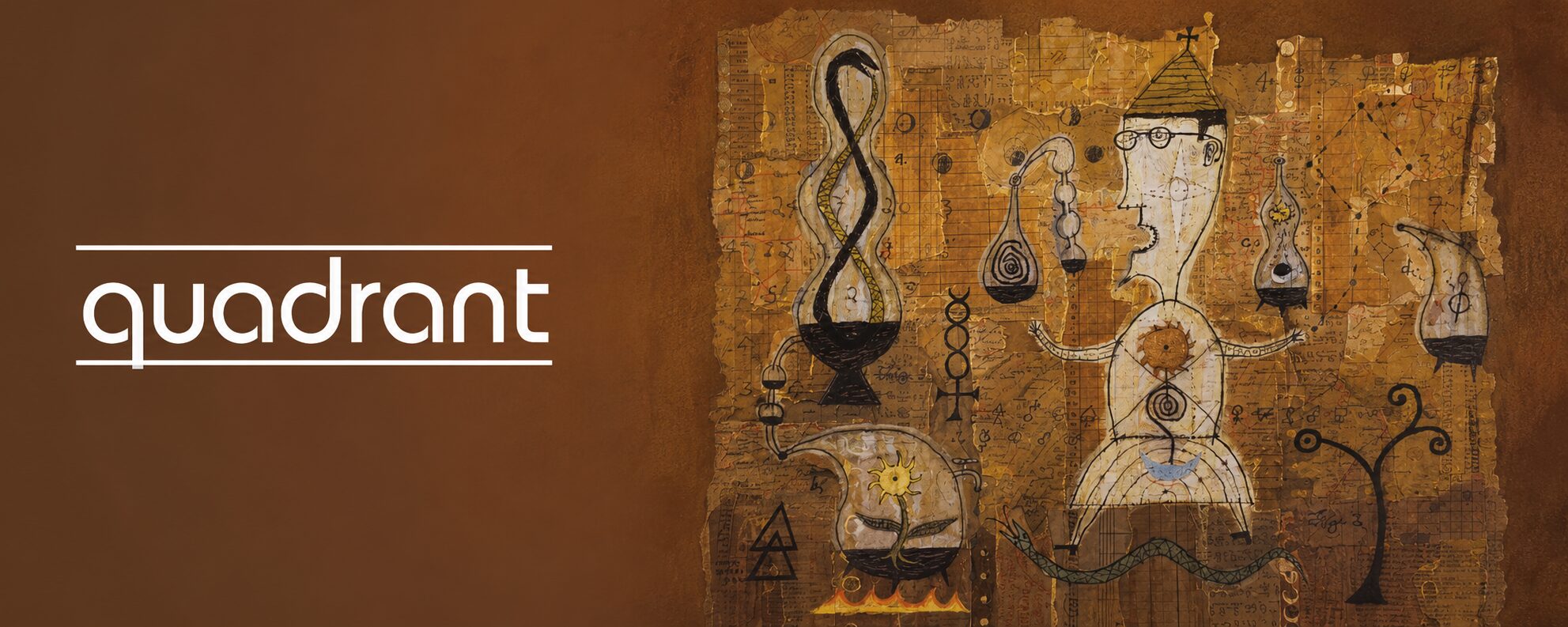
The latest issue of Quadrant arrives with a theme of alchemy and the creative process. All six essays in this issue were originally presented at the London Arts-Based Research Centre‘s second annual conference on alchemy, Alchemy: Exploring Metaphorical Transformations and Arts-Based Research.
Editor-in-Chief Kathryn Madden sets the scene. For Jung, she reminds us, alchemy’s significance lies not in its misguided attempt to produce physical gold but in its vast symbolic map of the individuation process. The medieval alchemists, Jung concluded, were unconsciously projecting the contents of the collective unconscious into their work. The alchemical stages (nigredo, albedo, and rubedo) serve as potent metaphors for the creative struggle, while the dictum solve et coagula (dissolve and coagulate) provides a framework for understanding how something new comes into being: first the dissolution of existing forms, then the coagulation of fluid potential into communicative shape. The cover art is David Nez’s contemporary alchemical work Solve et Coagula, now displayed at the University of Oregon’s Knight Law Center.
Sergio das Neves opens with his essay Literary Creation: An Alchemical Concern, arguing that literary creation and alchemy share a transformative essence that is grounded in deconstruction and recomposition. Drawing on Nietzsche’s concept of metaphor, das Neves situates alchemy as a dynamic practice that influences both psyche and intellect. He frames literary creation as an alchemical practice where metaphor and imagination are central to transmutation. Literature, in this reading, is a self-generating act embodying the ouroboric cycle of life and death, continuously dissolving and coagulating meaning.
Daniel Boland explores Natural Magic in the Poems of Robert Graves: Synchronicity, Alchemy, and the Anima Mundi, a rich pairing of the poet whose mythological imagination produced The White Goddess with Jung’s concepts of synchronicity and the world soul. Nikki De Marco’s Alchemy and the Creative Process: A Framework for Artistic and Psychological Renewal offers a directly applicable piece for practitioners, developing alchemy as a framework for understanding artistic and psychological renewal in tandem.
Bess Park contributes Breathing from Earth: Arts-Based Research as an Embodied Alchemical Inquiry, which brings the alchemical lens into dialogue with the somatic and the ecological. Katy Mahood’s The Alchemy of Metaphor promises a close engagement with language itself as a site of alchemical transformation. And Vicky Jo Varner closes the main section with Transformation through Alchemical Depth Typology, a title that suggests a synthesis of typological and alchemical frameworks.
The issue closes with book reviews edited by Beth Darlington, with contributions from Elaine Sedelnikova, Cory Douglas, and Ashok Bedi.
Quadrant is available by annual subscription at $35. Submission guidelines and subscription enquiries can be directed to cgjungny@aol.com.