
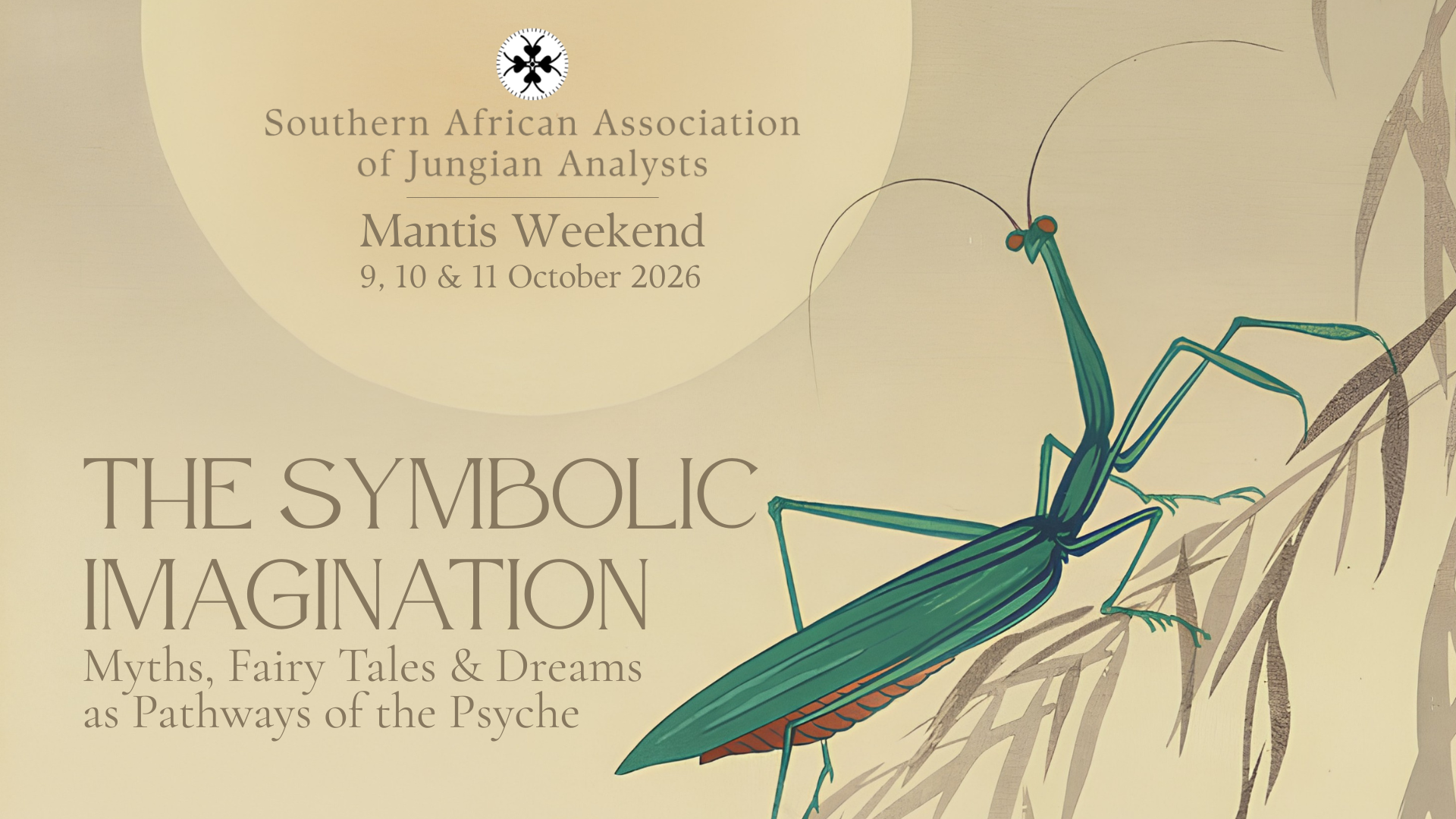
The Southern African Association of Jungian Analyst’s Mantis Weekend is back, running from October 9th to the 11th. This year’s theme is “The Symbolic Imagination: Myths, Fairy Tales, and Dreams as Pathways of the Psyche.” The weekend brings together Jungian analysts exploring how myth, fairy tale, and dream continue to speak to contemporary life.
Friday evening opens with Ian McCallum’s Once Upon a Time… Every Life is a Fairy Tale, built around the two lines that structure every life story: “Once upon a time…” and its darker, more consequential successor, “And then one day…” McCallum frames the second line as the catalyst that brings people into therapy, the uncalled-for event that sheds an old skin and forces the question every fairy tale eventually answers. Is this the end of the old story, or the beginning of a new one?
Saturday is a full day, opening with Charlotte Hoffman and John Gosling co-presenting on trauma and transformation through wound, descent, and fire, followed by Nici Partridge on Baba Yaga as witch and keeper of initiation. Dr Suzan Hojdar then delivers two sessions: the first, Bluebeard: How the Feminine Claims Authority Through Refusal and the Courage to Know, reads the tale as an image of the negative animus, tracing how the young woman’s refusal to comply, rather than her obedience, becomes the seed of consciousness and the recovery of instinctive feminine wisdom. Her second talk widens the lens to how fairy tales, myths, and dreams shape inner authority more broadly.
Sunday opens with Stephen Bloch on sea shanties and the human condition, joined by musicians Nielen Prinsloo and Rob Anderson for live musical examples. Sea shanties, Bloch notes, were work songs that coordinated labour and built camaraderie aboard 18th- and 19th-century sailing ships, and the genre had an unlikely resurgence during the Covid-era “Wellerman” phenomenon. The session explores embodiment and music, the archetypal images of ocean, whale, and Leviathan, and mythological undercurrents in Moby Dick and the Book of Jonah, continuing a Mantis Weekend thread on archetypes in traditional music and the notion of an acoustic image. The weekend closes with Denise Grobbelaar on dreams as personal mythology and embodied psyche..
In-person attendance is limited to 20 tickets (R1,750 or $110 for the full weekend), while online attendance via Zoom is available as a full package (R1,500, with a 50% student discount) or by individual lecture (R350 or $22). Recordings are available to all registered participants and bookings close at noon SAST on October 7. CPD credits are available.
You can save your spot, read the full programme, and access speaker bios here.
The meaning behind the mantis
The name Mantis carries particular meaning for SAAJA. Its founders drew on San culture’s shape-shifting trickster deity Kaggen, who appears as a praying mantis, and the organisation’s logo features four mantis heads arranged in a circle. In alchemy the mantis corresponds to Mercurius, the paradoxical trickster-creator Jung recognised as an archetype of the Self and the drive toward individuation.