
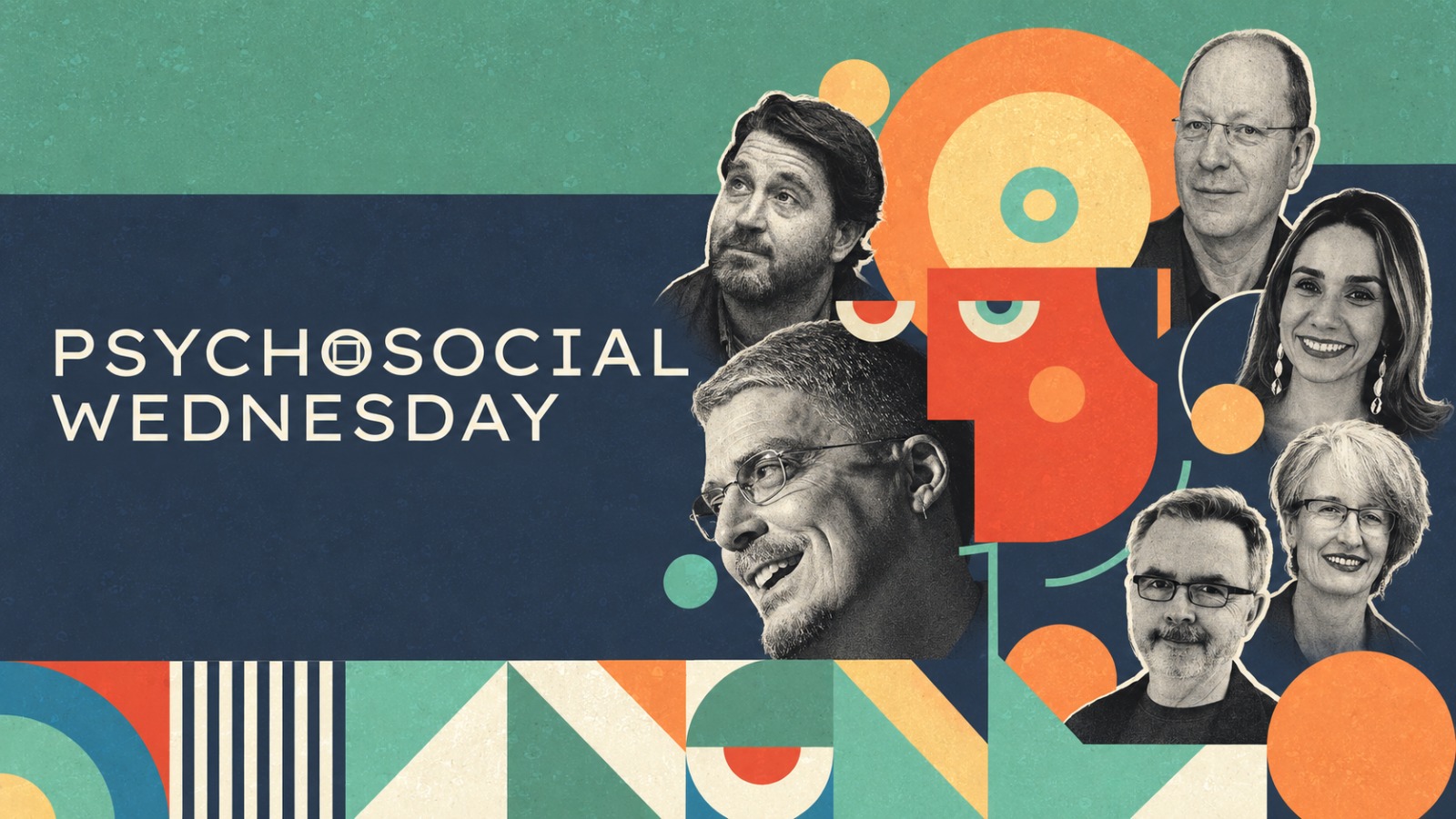
In April 2020, as the world was just beginning to close its doors, Stefano Carpani sent out a single email. It was an invitation, co-organized with Bernhard von Guretzky and Paul Attinello, to a digital salon modeled on Freud’s original Wednesday meetings — a gathering that would bring Jungian and post-Jungian voices into conversation with relational, feminist, psychosocial, liberation, and existential traditions. Their first speaker, in May of that year, was Susan Rowland. Some analysts greeted the invitation with trepidation; meeting online was, at the time, still a novelty, and remote attendance had long been the exception rather than the norm. Yet what began as a response to isolation became something far more enduring. Over the six years since, Psychosocial Wednesdays has grown into a vibrant forum, a treasured place to meet colleagues across continents, and — long after the isolation of those early years faded — a global digital salon that has remained at the forefront of psychosocial discussion within the Jungian community.
After their spring break, Psychosocial Wednesdays returns next Wednesday, September 23, with a presentation that turns to sisterhood as a site of individuation. Carmen Livia Girade Parise asks why bonds between women have been so consistently overlooked in psychology, despite their transformative potential, drawing on Jungian psychology, feminist theory, and lived experience — including a women-led urban occupation — to explore sisterhood as both a clinical and political practice. The webinar will be held in Portuguese with simultaneous English translation. To register, please visit their Facebook page.
If technology and the posthuman are your thing, Glen Slater’s talk on AI, posthumanism, and the collapse of inner ecology, from March 12, 2025, is well worth a watch. Kevin Lu’s talk on decolonising Jungian and post-Jungian curricula goes back further, to July 14, 2021, but still feels ahead of where much of the field’s self-examination is only now catching up.
For those interested in archetype theory and the shape of the discipline itself, Christian Roesler’s May 15, 2024 talk, “Archetype Theory for the 21st Century,” is worth revisiting alongside his more recent follow-up on April 22, “Rethinking Jungian Psychology,” a reformulation of much of that same territory a couple of years on. George Hogenson’s September 15, 2021 talk on symbolic density and complex systems makes for good companion viewing.
On gender and the feminine, Claudette Kulkarni’s June 12, 2024 talk calling for a rehabilitation of Jung’s theory of “the sexes” pairs naturally with this week’s session. Pia Skogemann spoke on adult female development on January 15, 2025, while Susan E. Schwartz’s January 13, 2021 talk on absent fathers and daughters remains the channel’s most-watched video by a wide margin, with over 27,000 views.
For those drawn to culture and collective trauma, Tom Singer’s May 20, 2020 talk “Cultural Complexes and the Soul of America” and Kathleen Kirgin’s December 11, 2024 session on Ireland’s cultural complexes both explore how history lodges itself in the collective psyche. Karin Fleischer’s talk, “At the Train Station: The Self, Suspended in Collective Trauma,” dates to June 14, 2023, and Betty Sue Flowers’ Jungian reading of US democracy in transition, from April 16, 2025, rounds out this thread nicely.
Co-founder Stefano Carpani has spoken on the series himself more than once, notably on November 15, 2023, with “From the Suspension to the End of Certainties: War as Reset,” a fitting entry from one of the people who built the format. And if you’re after something a little different, the channel has also hosted a handful of book launches worth knowing about, including Mary Watkins’ March 13, 2024 launch of Opening to the Imaginal and Renate Daniel’s March 15, 2023 launch of The Self: Quest for Meaning in a Changing World, alongside talks ranging from depth psychological astrology to Jungian music psychotherapy.
The full archive, with dozens more talks across astrology, embodiment, synchronicity, and clinical practice, is available on their YouTube channel.