
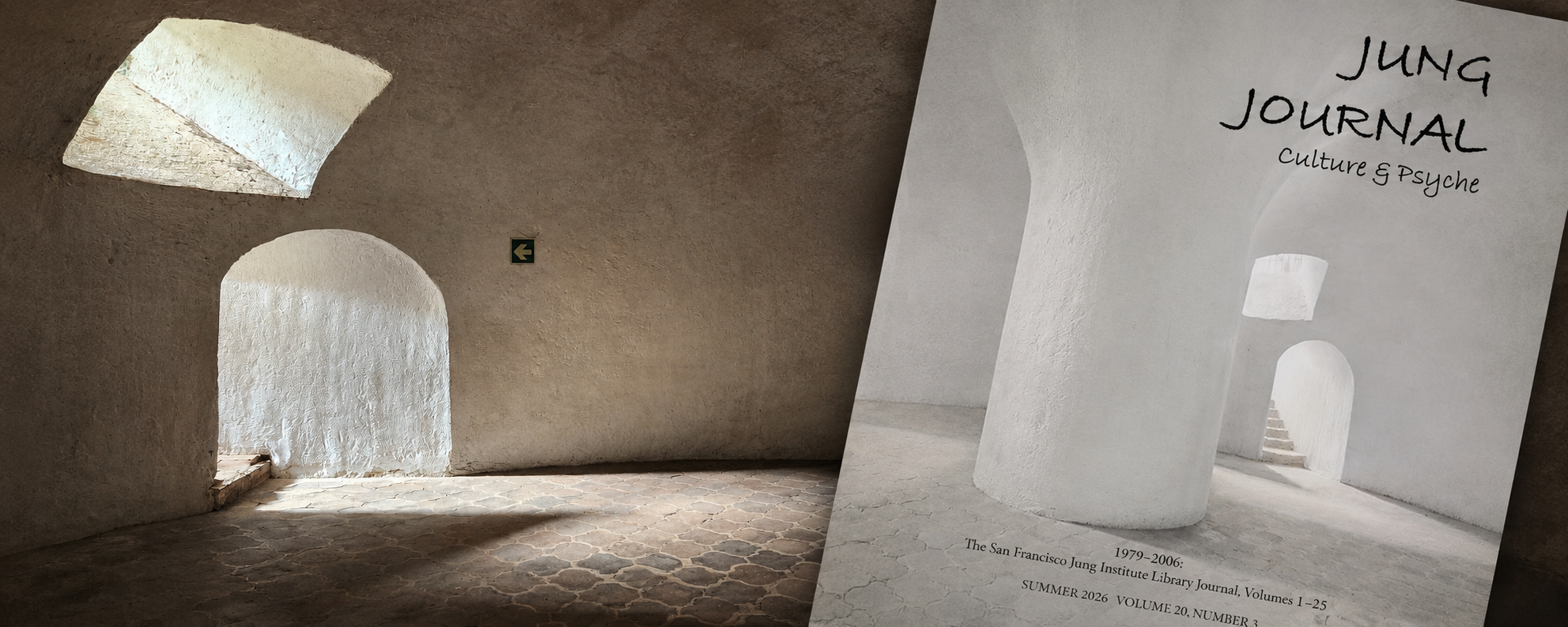
The newest issue of the Jung Journal is out now. Editor Audrey Punnett opens this issue (free to read) with a personal note on the cover image, a photograph by Steve Dzerigian she calls a longtime favourite for its spiritual quality. The choice led naturally to this issue’s interview with Dzerigian himself, “Being in the Moment: Connection and Resonance in Photography,” in which the Central California-based photographer, who has devoted over 45 years to art and teaching in the region, discusses photography as his primary tool for investigation and contemplation.
Two research articles anchor the issue. In Synchronicity and the Poltergeist (open access), Jingchao Zeng puts Jung’s concept of synchronicity in dialogue with Sándor Ferenczi’s Poltergeist theory, tracing how the two men, both early allies of Freud who wrote on the paranormal at the very start of their careers, arrived at fundamentally different metaphysical conclusions. Zeng traces Jung’s fascination with the paranormal back to his own family history of mediumship and clairvoyance, and to specific episodes including his 1909 bookcase “detonation” with Freud and his precognitive 1913 vision of a great flood, before arguing that recent post-Ferenczian and post-Bionian work is now converging with Jung’s own view, opening space for renewed dialogue between the Jungian and psychoanalytic schools.
Cody Peterson’s The Iron Thūmos and the Empty Vessel (open access) reads Jung’s Answer to Job alongside Homer, arguing that Job’s suffering reveals something divine power alone cannot produce: the capacity to create value. Peterson identifies Mortality’s Three Constraints, which are permanent loss, radical uncertainty, and utter powerlessness, as the conditions under which value is forged in the soul. He traces how Homer’s systematic exclusion of gods from the vocabulary of mortal suffering encodes precisely the boundary Jung’s theology predicts, and argues that Yahweh’s need to “become man” proves that value can only be created, never merely known or transmitted.
Elsewhere in the issue, John Beebe and Chenghou Cai examine divination and consciousness, and Catarina Vezzoli and Livia Di Stefano turn to the Red Book’s amplifications on divine folly in the context of analytic training during trauma. Raffaele Floro contributes an essay on myth, loss, and analysis, while Joel Crichton continues his multi-part exploration of Shakespeare’s Henriad. The issue also features poetry from Julia Alvarez, a run of shorter personal essays in the Blocks & Mortar section, and D. Steven Nouriani’s piece on the Tree of Life for ARAS.
The Review section closes out the issue with three book reviews: Michael Dolzani on Craig E. Stephenson’s Ages of Anxiety: Auden Reading Jung in Times of War, Shoshana Fershtman on Barbara Morrill’s study of Etty Hillesum’s Holocaust writings, and Dragana Favre on Susan E. Schwartz’s An Analytical Exploration of Love and Narcissism. Two brief corrections round out the issue, addressing an editing error in a previous piece and a misprinted hexagram.
You can see the full list of articles along with the open access pieces, here.
(Cover image: Steve Dzerigian, “Singing Room,” Convento de las Capuchinas, Antigua, Guatemala. From Trail of Stones: My Path in Photography.)
You can read more about the Convento de las Capuchinas, here.