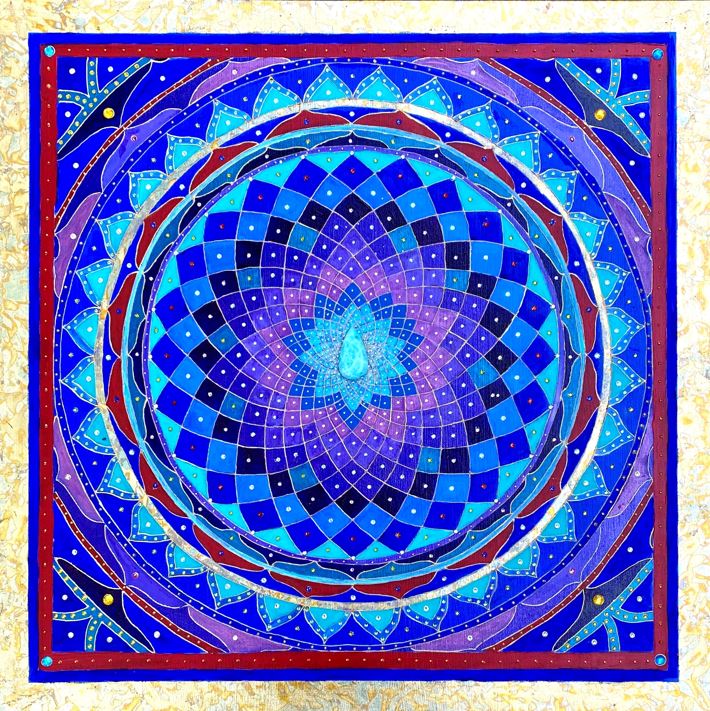
Jung’s capacity for creative expression both enlivened and informed his relationship with the unconscious throughout his lifetime. Perhaps one of the most profound discoveries was the art of mandala making as a tool to develop a more conscious relationship to his internal world, which proved invaluable during a particularly challenging time in his personal life. Each class in this series will include a theoretical perspective of Jung’s work, followed by an experiential portion in which participants will have the opportunity to create their own mandala as a form of personal expression.
Learning Objectives:
- Describe what Jung meant the Self and its role in the analytic process;
- Describe Jung’s theories about the role of the mandala as a symbol of psychological wholeness;
- Describe the functions of the mandala in different cultures and how mandala making is utilized symbolically to help individuals restore a sense of internal balance;
- Describe how Jung used the mandala as a way of gaining a greater psychological understanding of himself;
- Describe the significance Jung placed on mandalas when they appeared in the dreams of his patients;
- Describe how the act of mandala making can be utilized to help patients identify unconscious conflicts;
- Give an example of how mandala making can reflect a parallel process to the patient’s analytic work;
- Give an example of when it would be appropriate to introduce mandala making in the course of treatment;
- Give an example of how to evaluate the effectiveness of using mandala work with a client.