
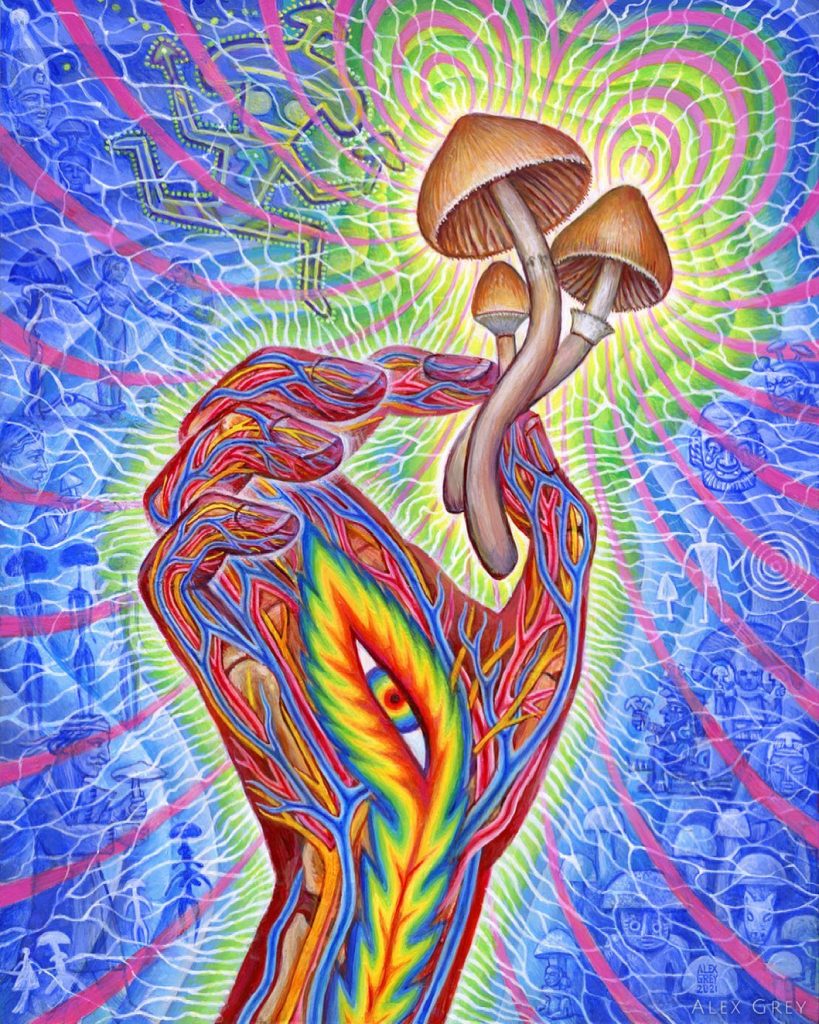
In 1954, becoming aware of the enthusiasm for psychedelics expressed by well-known thinkers such as Aldous Huxley, Jung wrote his concerns to his friend Father Victor White: “There are some poor impoverished creatures, perhaps, for whom mescalin would be a heaven-sent gift without a counterpoison, but I am profoundly mistrustful of the ‘pure gifts of the God.’ … you pay very dearly for them.”
Understanding the power of psychedelics to quickly open the contents of the unconscious, Jung continued: “But it soon becomes dangerous to know more, because one does not learn at the same time how to balance it through a conscious equivalent. That is the mistake Aldous Huxley makes: he does not know that he is in the role of the “Zauberlehrling,” who learned from his master how to call the ghosts but did not know how to get rid of them again.” Jung also wondered whether there would be harm from using psychedelics “out of idle curiosity.” He told his friend: “I only know there is no point in wishing to know more of the collective unconscious than one gets through dreams and intuition. The more you know of it, the greater and heavier becomes our moral burden, because the unconscious contents transform themselves into your individual tasks and duties as soon as they become conscious. Do you want to increase loneliness and misunderstanding? Do you want to find more and more complications and increasing responsibilities? You get enough of it.”
In the contemporary psychedelics renaissance, Pandora’s Box has already cracked open. Thousands of Westerners journey every year to the Amazon basin or Central America in search of spiritual awakening with Ayahuasca or San Pedro, while as many underground groups gather in cities around the world for psychedelics ceremony with these and other medicines. Inner explorers are bringing their experiences, their unleased processes, and sometimes their psychedelics trauma into psychotherapeutic practices. Meanwhile, with the prohibition against psychedelics research having ended, and the mental health crisis not abating, respected researchers at prominent research facilities are once again demonstrating the value of psychedelics in healing from trauma, addiction, anxiety, and depression – and in finding comfort and peace with a terminal illness. Stories in the media about the benefits of psychedelics have exploded – and increasing attention to the perils is not likely far behind. Clinics administering psychedelic treatments in various forms are opening around the world, with enormous attention from investors, whose motives and tactics run the usual capitalist gamut.
In this “wild west” of a renaissance, Jung’s concerns remain valid. Are we ready to handle what is being unleashed? Albert Hofmann, the discoverer of LSD, believed his “problem child” fell into such turmoil in the 1960s and 1970s because our culture had no mature structures to hold the power of psychedelic experiences. Over half a century later, what has changed? Is the medical model – and the market forces of contemporary health care – right for holding the power of psychedelics? If these “medicines” are spiritual sacraments, what are our practices, lineages, and structures for respecting and honoring the “direct” route to God? Are our therapists and clinicians experienced enough themselves with the power of psychedelics to enter into the psychedelic terrains with clients?
In this series of three Sunday morning meetings, we will consider these questions and more from a depth psychological – as well as practical – perspective. The first gathering will look at the psychedelics renaissance across the US and the world – including contemporary research, the emerging lawful use of some psychedelics in clinical settings, and the issues surrounding the ceremonial use of “sacred medicines” outside traditional cultural contexts. In the second gathering, we will look at the experiences typically offered by the various psychedelics most commonly used in the renaissance: MDMA, psilocybin, ketamine, LSD, ayahuasca, and others. The promises and perils of the particular “medicines” will be considered. The third gathering will look at the “art of opening Pandora’s Box.” What are the best models, therapist preparation, skills, and set and setting for offering positive, healing, and empowering experiences with psychedelics? What are the best therapeutic approaches for helping experiencers prepare and integrate such potentially life-changing dives into the depths of the unconscious? To return to Jung’s question, for those of us wishing to help others, and our world, in a challenging time, what are our responsibilities and “moral burdens” if we enter into the psychedelics field?
