
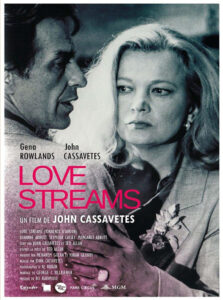
Love Streams (1984) is effectively the final work of director-writer-actor John Cassavetes over which he had total creative control. Based on a semi-autobiographical play by Canadian writer Ted Allan (Lies My Father Told Me, 1975), Cassavetes adapted it to conform to his own ‘extended family’ circle: he and his wife, the great Gena Rowlands, take the lead roles of brother and sister, and it was mostly shot inside their own home, with their usual crew of relatives and friends. Cassavetes stated succinctly at the outset that Love Streams is about “the problem of love, and where to put it”. It traces two very different styles of loving, alternating in its first hour between the decadent, dissolute night-world of divorcée Robert (Cassavetes), and the overflowing, sacrificial, family-centred acts of soon-to-be-divorced Sarah (Rowlands). Yet both of these people are wounded, dysfunctional, yearning for a wholeness that eludes them.
To fully explore the consequences of the time Sarah and Robert eventually spend together, Cassavetes spontaneously threw out the script well into the production, and began to invent remarkable scenes, including two extraordinary dream sequences. In fact, as Cassavetes confided to journalist Michael Ventura (co-author with James Hillman of We’ve Had a Hundred Y