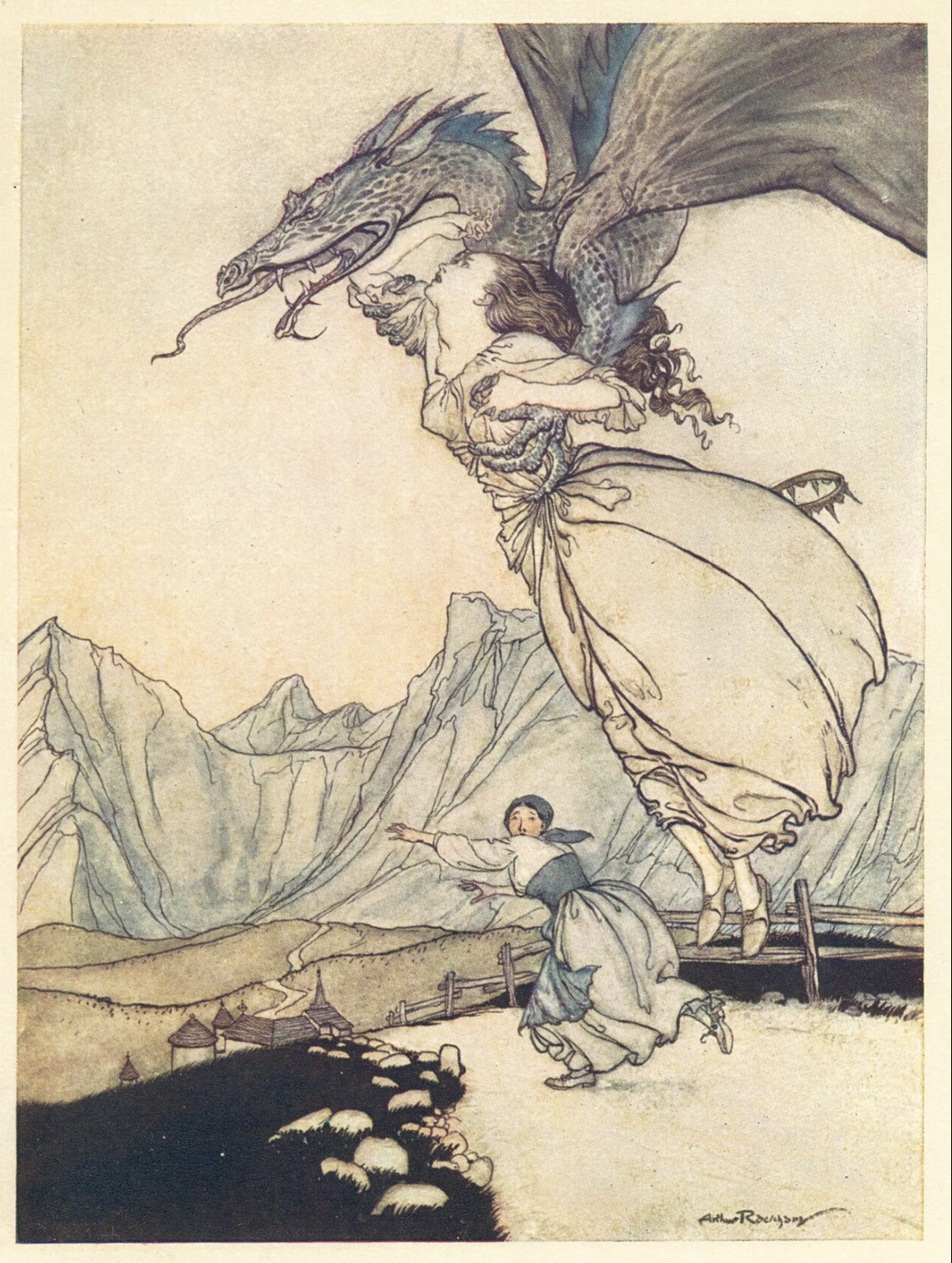
Once a month, Society members and other lovers of the power of story and the Jungian approach to understanding and developing ourselves, meet for Fairy Tale Fridays. In each story we find shadow, complexes, anima, animus, soul, ego, alchemy, and the numinous, all guiding us on a journey toward selfhood.
In these group discussions we start to understand how to interpret the story, as well as the task of translating the fairy tale into a psychological language.
Suggested reading: The Interpretation of Fairy Tales by Marie Louise Von Franz.
Fairy Tale Discussion Learning Objectives
How do we approach the meaning of a fairy tale?—or stalk it, rather, because it is really like stalking a very evasive stag. p. 37
1). Just as for a dream, we divide the archetypal story into the four stages of the classic drama, beginning with the exposition (time and place). In fairy tales time and place are always evident because they begin with “once upon a time” or something similar, which means in timelessness and spacelessness—the realm of the collective unconscious. p. 39
2). Then we turn to the dramatis personae (the people involved). I recommend counting the number of people at the beginning and end. If a fairy tale begins, “The king had three son,” one notices that there are four characters, but the mother is lacking. The story may end with one of the sons, his bride, his brother’s bride, and another bride—that is, four characters again but in a different setup. Having seen the mother is lacking at the beginning and there are three women at the end, one would suspect that the whole story is about redeeming the feminine principle. p. 39
3). Now we proceed to naming the problem. You will find this in the form of the old king who is sick, for instance, or the king who discovers every night that golden apples are stolen from his tree, or that his horse has no foal, or that his wife is ill and somebody says she needs the water of life. Some trouble always comes at the beginning of the story, because otherwise there would be no story. So you define the trouble psychologically as well as you can and try to understand what it is. p. 39
4). Then comes the peritpeteia—the ups and downs of the story—which can be short or long. This can go on for pages because there can be many peripeteias: or perhaps you have only one, and then you generally get to the climax, the decisive point, where the whole thing develops into a tragedy or comes out right. It is the height of tension. Then, with very few exceptions, there is a lysis, or sometime a catastrophe. p. 40
The formulas at the end of a fairy tale are a rite de sortie, because the fairy tale takes you far away into the childhood dream world of the collective unconscious, where you may not stay. We have to be switched out of the fairy tale world. p. 41
5). Amplification: Take each symbol and amplify its meaning. Amplification means enlarging through collecting a quantity of parallels. p. 43 Construct the context. Take the amplification that best fits the particular story.
6). Then comes the last essential step, which is the interpretation itself—the task of translating the amplified story into psychological language. p. 44 What conscious situation does the fairy tale compensate?