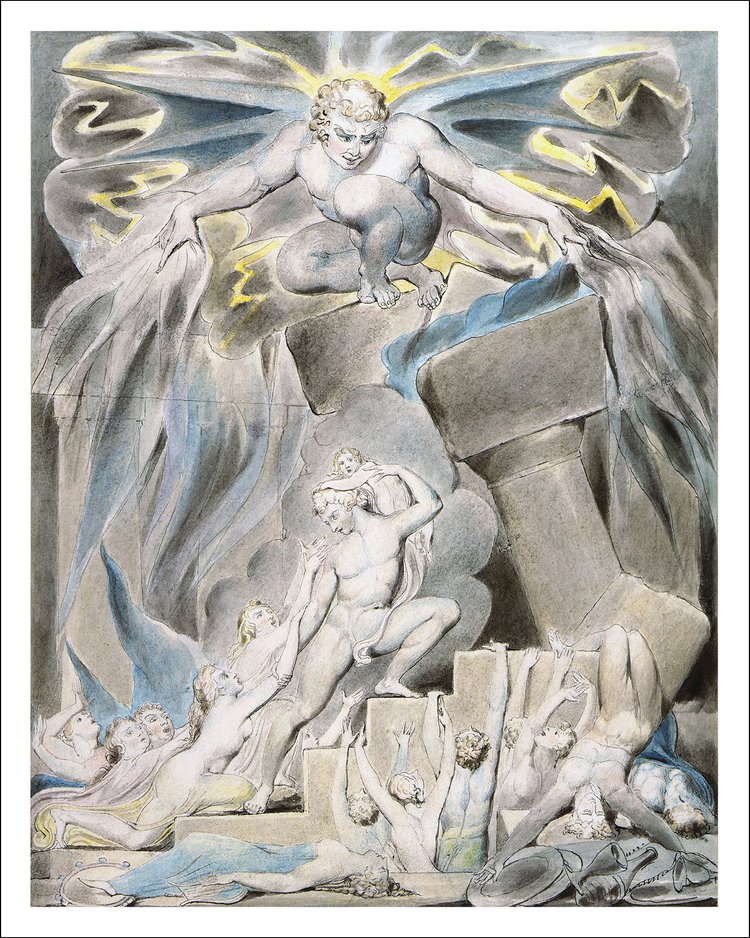
“The unconscious mind of man sees correctly even when conscious reason is blind and impotent. The drama [the “Divine Drama”] has been consummated for all eternity: Yahweh’s {God’s} dual nature has been revealed and somebody or something has seen and registered this fact. Such a revelation, whether it reached man’s consciousness or not, could not fail to have far-reaching consequences.”— C.G. Jung: ‘Answer To Job’ chap 2, 808.
Even though the Book of Job was written in a world vastly different from our own, Jung felt it served as a paradigm for a certain experience of God, one that has “special significance for us today.” We still grapple with fundamental questions: Does life have a meaning beyond bare existence? Why do the ‘righteous’ suffer? Why do the ‘guilty’ seem to prosper? Is it worthwhile to aim to be a ‘good’ person? Jung says…“All opposites are of God, therefore man must bend to this burden. And in so doing, he finds that God in his “oppositeness” has taken possession of him, incarnated himself in him. He becomes a vessel filled with divine conflict.” C.G. Jung CW 11 Par. 664In Jungian terms, the Book of Job can be seen as representing an account of an archetypal experience of the ego encountering the Self, which comprises four basic steps:
The Encounter: between the ego and the cosmic powers;
The Suffering: the experience the ego goes through;
The Scrutiny: the examination of what is experienced for its ‘meaning’:
The Reward: the gaining of insight into the transpersonal realm sufficient that it satisfies the ego, and (to some extent) answers the question posed by the initial experience.
This talk is an Overview of Job and its historical roots as an oral story that was later written down and included as one of the ‘Wisdom’ texts of the Bible (The Old Testament). It will explore the arguments that emerge from the various dialogues that make up the poetic structure of the Book of Job and discuss the issues that are raised about the nature of God and the relationship to humanity.In the story, Job is confronted with the inexplicable nature of good and evil and the inevitable question is: “Why?”- for what purpose was Job persecuted? Jung said this (“Job’s central problem”) that “had occupied him for years” before he wrote his considered response, “Whoever talks of such matters inevitably runs the risk of being torn to pieces.”