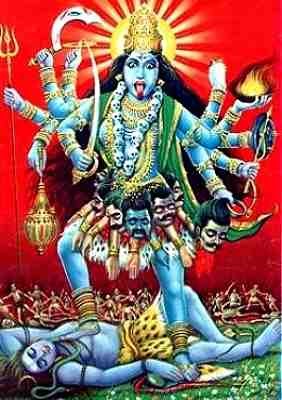
Hinduism can offer an apt and nuanced way of understanding the complex workings of the psyche. The way that it employs shapeshifting and tricksterism, for example, underscores the way that the mythology captures dynamics that are beyond conventional understandings of rationality and morality, without some of the prejudices inherent in western mythology. Its imagery is able to symbolize at once the changeable and multifaceted nature of psychic movement while the myths depict processes that are ongoing and continually developing, taking different twists and turns and with multiple end-points. It is a mythology that allows for the both/and.
This talk will focus on the Hindu goddess Kali, whose name refers to time, black and death. Often depicted in horrific form, she has generally been portrayed as an image of the Terrible Mother in western psychology. In India, though, Kali, as a manifestation of the divine feminine, is mainly seen as savior and protector. This talk will explore the myth of Kali as portrayed in the Devi Mahatmyam, the 2,500-year-old religious text translated as “In Praise of the Goddess,” wherein Kali is engaged in the epic battle to save the gods. The talk will include a historical and philosophical background and will apply a symbolic understanding of the story to clinical understanding and practice.
Learning objectives:
- Explain how mythological figures can symbolize the changeable and multifaceted nature of psychic movement.
- Explain how myths and images can help therapists understand how their patients experience their lives and how they relate to others.