
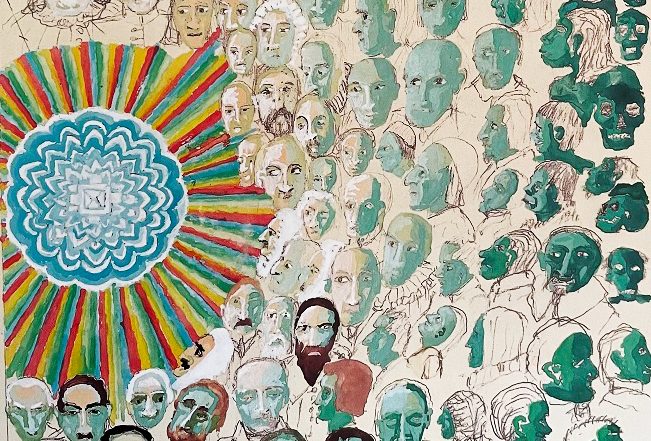
On a January Sunday in 1916, Carl Jung’s Zürich household became, to put it mildly, spiritually overcrowded. The air thickened like bad soup, the doorbell rang with no one at the door, and Jung found himself hosting what he described as a houseful of dead souls—all the way from Jerusalem, apparently disappointed with their trip. For a man who’d spent his teenage years transcribing the pronouncements of spirits channeled through his cousin Hélène Preiswerk at séances in Basel, this was perhaps not entirely unprecedented domestic chaos, but it was certainly inconvenient. Yet from this bizarre metaphysical home invasion emerged the Septem Sermones ad Mortuos—the Seven Sermons to the Dead—a fever-dream of Gnostic cosmology that Jung would later half-disavow, half-treasure, like an embarrassing photo from one’s youth that nonetheless captures something essential.
Next week, The C.G. Jung Club London presents an immersive dramatic reading of C. G. Jung’s The Seven Sermons to the Dead, offering a unique opportunity to experience this foundational text as a powerful, spoken-word event. The reading aims to bring the material to life in a way that resonates with Jung’s original lived experience, fulfilling the conviction that speaking the text aloud in a group setting unlocks its profound psychological and mythological dimensions.
The Sermons emerged from what Jung called his “confrontation with the unconscious”—that fertile, terrifying period between 1913 and 1917 when he systematically descended into his own psyche and expeirenced the visions and revelations recorded The Black Books and his monumental Liber Novus (The Red Book). He would later insist these visions contained “the nucleus of all my later works,” though he remained peculiarly cagey about them, privately printing the Sermons to the Dead in 1916, but excluding them from his collected works, as if they were simultaneously too precious and too embarrassing to fully own.
In the text we see how Jung imports Gnostic cosmology into depth psychology: the pleroma (divine fullness-emptiness), Abraxas (the god above God and Devil), and the principium individuationis all foreshadowed Jung’s mature theories. Here was the collective unconscious spelled out in archaic language, the problem of opposites wrestling toward integration, and individuation as humanity’s essential task—all delivered by a deceased Alexandrian Gnostic speaking through a Swiss psychiatrist’s dining room.
The immersive reading acknowledges Jung’s understanding that this text was a matter of lived experience and not just passive reading. By assigning roles to different voices—Philemon, Jung, his Soul, and the collective voice of the Dead—the event transforms the abstract prose into a potent drama of psychological encounter.
The evening’s readers, all distinguished Jungian analysts and scholars, lent their voices to these archetypal figures:
- Philemon: Robert Macdonald (Jungian Analyst, IGAP)
- C. G. Jung: Max Noak (Jungian Analyst, SAP, Harvest Editor)
- Soul: Heba Zaphiriou-Zarifi (Jungian Analyst, GAP)
- The Dead: A chorus formed by Gail Bennett (Jungian Analyst, GAP), Stephan von Bismarck (Club Treasurer), and Stella von Boch (Jungian Analyst, IGAP, Club Chair).
Adding a layer of emotional and atmospheric depth, the reading will be accompanied by musical interludes featuring the Violin, performed by Eulalie Charland. This synergy of spoken word and music provided a powerful, collective experience of the transformative energies inherent in Jung’s confrontation with the deep unconscious.
* the above illustration is a detail of a drawing by C. G. Jung in The Red Book: Liber Novus, page 169