
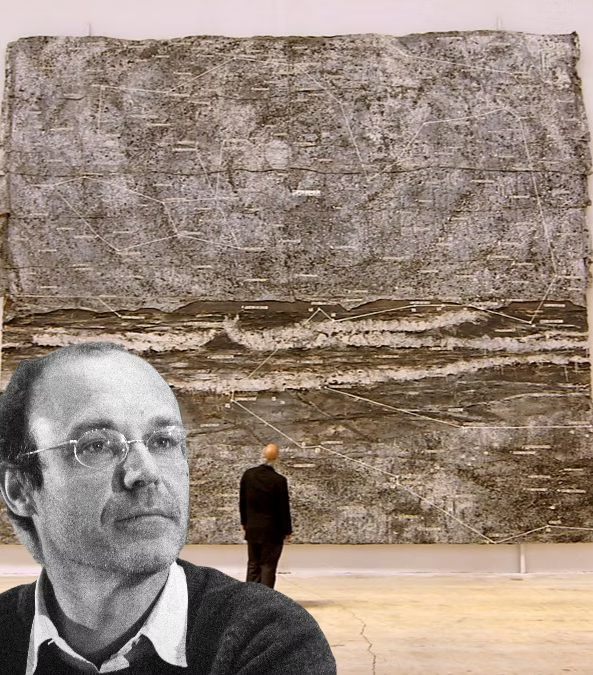
Anselm Kiefer is a singular figure in contemporary art. His large, demanding works face Germany’s twentieth-century catastrophe directly and refuse to soften it through beauty, explanation, or moral reassurance. Using materials like lead, ash, straw, concrete, and burned books, Kiefer works with history and myth as things that still press on the present. These are not stories that can be finished.
He has often been described—sometimes with admiration, sometimes with unease—as brilliant, controversial, or even “bonkers.” What has never changed is his conviction that painting can still carry real weight. Born in 1945, surrounded by the ruins left by the collapse of the so-called Thousand-Year Reich, Kiefer grew up inside a landscape shaped by forces that had already done their worst. His early work engages what Carl Gustav Jung called the Wotan archetype. In Kiefer’s hands, it appears as something that overtakes a culture and then lingers—felt in what follows, and in what later generations inherit without having chosen.
The BBC documentary Remembering the Future focuses on Kiefer’s working process and his later projects, including the 2016 exhibition at the Royal Academy. The film is visually rich and measured in tone. It observes rather than presses, allowing the work to speak without forcing interpretation. After the screening, we will return to Kiefer’s earlier, more unsettling work through a short presentation and discussion of Rafael López-Pedraza’s book Anselm Kiefer: The Psychology of “After the Catastrophe” (1996), which approaches these images from a Jungian perspective and stays with their psychological consequences.
Kiefer’s work bears witness to what happens when a culture turns away from its own shadow. He does not diagnose or accuse. Instead, he leaves open a harder question: what follows when societies imagine themselves innocent, chosen, or somehow outside of history? Sitting with that question may help us look more carefully at our own cultural stories—and at what those stories leave unattended.
Together, the film and discussion invite reflection on what it means to live after catastrophe. Guilt alone no longer suffices. Innocence cannot be claimed. What remains is the work of remembering, not as comfort, but as responsibility.
