
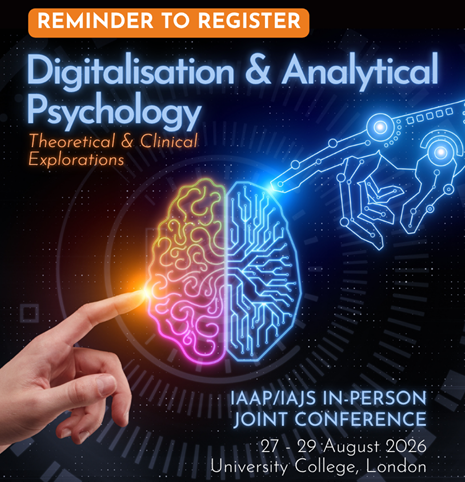
This is a last call for registration for “Digitalization and Analytical Psychology: Theoretical and Clinical Explorations,” the joint IAAP–IAJS conference taking place August 27–29 at UCL’s Institute of Education in London. The conference is set to gather over 60 presenters across three days, with the abstracts booklet alone running over fifty pages. We’ve picked out a handful of papers that give a sense of the conference’s range, from clinical case work to speculative theory to outright provocation.
Opening framings
The conference takes as its starting point two passages from Jung on technology: his observation in Civilization in Transition that technology is “neither good nor bad” but shaped by the attitude brought to it, and his warning in Two Essays on Analytical Psychology that rationalist, technological consciousness tends to repress the irrational, eventually provoking an unconscious counter-reaction. The organisers frame the conference around five guiding questions: how analytical psychology continues its work in radically changed settings, how digitalization reshapes the therapeutic contract and relationship, what digitalization’s unconscious meanings might be, and how technology used for political ends exacerbates cultural complexes. Sonu Shamdasani opens the conference with a plenary on the transformation of therapeutic modalities across Jung’s own practice, from presence and absence to correspondence and virtual mediation.
A few standout papers
Andrew Samuels closes out Friday with a provocative plenary, “The New Jung Cult: On Removing the Flesh from Analytical Psychology and Jungian Studies,” extending an argument he first raised at the 2025 IAAP Congress in Zurich: that cultic tendencies persist in the field, now channelled through analysts’ websites, online personality tests, and digital material about “Jung the Man.” He promises an anecdote involving a spoof AI interview with Donald Trump.
Susan Laurance offers an unusual contribution, “When A.I. Meets AI,” presenting a year-long dialogue of 205 conversations with Claude AI in which she turns active imagination’s own method directly onto the AI itself, asking whether it participates in archetypal process and proposing that AI dialogue may require an entirely new category between projection and objectivity.
Susan Schwartz’s “AI, Frankenstein, and Analytic Transferences” presents a clinical case of a man who identifies more with AI than with his own body, understanding himself as a kind of Frankenstein’s monster raised by screens rather than people. Toshio Kawai, former IAAP president, appears in a Saturday morning plenary conversation with Orsolya Lukács, whose own paper elsewhere in the programme asks whether generative AI is eroding critical thought and human agency. And Kevin Lu’s Virtual Unconscious research group presents ongoing work exploring how VR and AR can facilitate encounters with Jungian concepts, particularly for Gen Z and Gen Alpha.
Several papers turn specifically to cultural and political dimensions: Cole Neer applies Jung’s transcendent function to American political polarisation, Roy Lindelauf examines AI-enabled warfare through the lens of projection and shadow, and Malgorzata Kalinowska traces how social media’s viral dynamics have intensified cultural complexes, drawing on her long study of Polish collective reactions since the Smolensk crash.
This snippet of what is to come only scratches the surface, and the abstracts booklet includes dozens more papers on everything from VR and video games to AI-assisted movement analysis, Shinto vessels and cosmetic surgery, and a Jungian read of The Legend of Zelda. You can access the full abstract booklet with speaker bios here. And, you can click here to view the full program of events.