
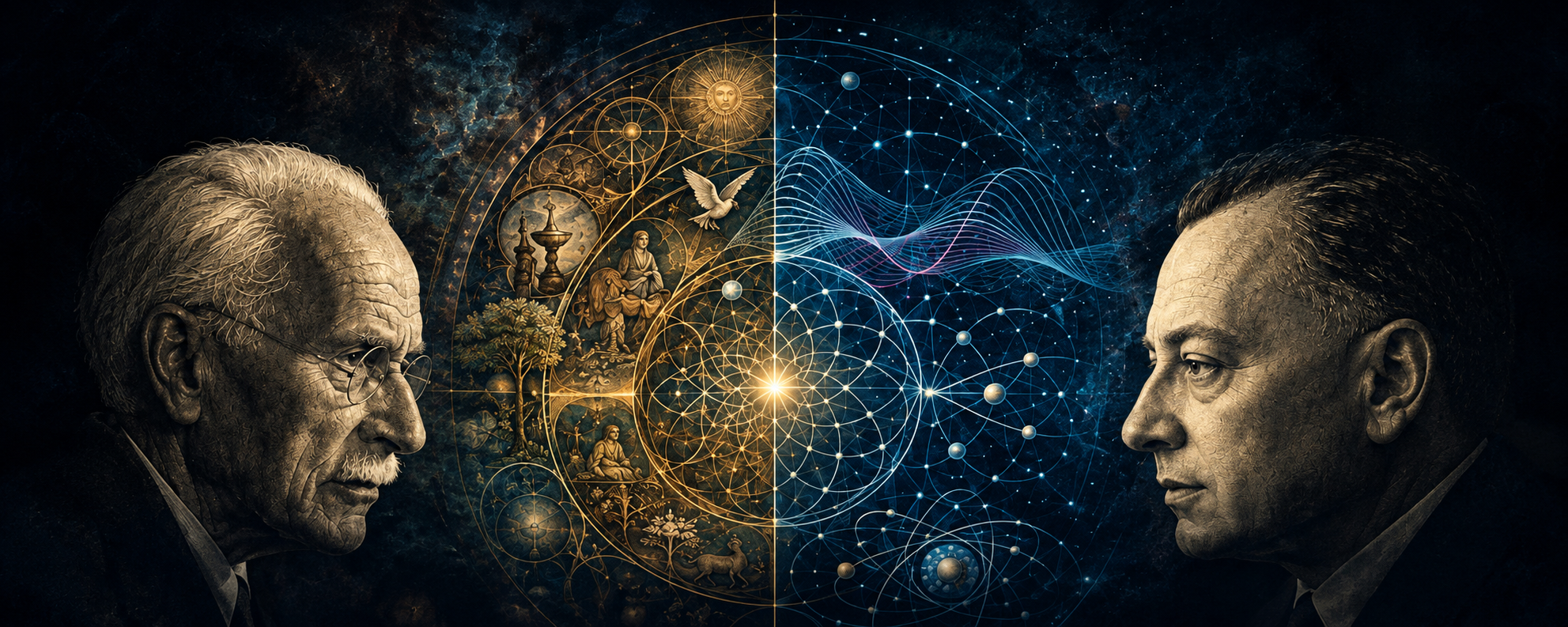
In 1932, the physicist Wolfgang Pauli, who would win the Nobel Prize in 1945, turned to Jung for help. By the end of 1931, Pauli had lost his mother, his marriage and, increasingly, his grip on his own mind. His mother had taken her own life in 1927, around the time his father had left the family for a woman of Pauli’s age. He married in 1929, and the marriage lasted less than a year. He drank heavily, spent his nights in Hamburg’s bars and red-light district, and began to have visions that were seeping into his waking life. In early 1932, on his father’s advice, he went to see Carl Jung. What began there grew into a correspondence that ran until 1958. In it they discussed dreams, the nature of reality, and the common ground between depth psychology and quantum physics.
That exchange is the subject of Beyond Jung: Jung and Pauli, a six-part online series hosted by the Pari Center. It runs over three weekends, from Saturday 14 November to Sunday 29 November 2026.
The series opens on Saturday 14 November 2026 with Roderick Main, who reads Jung and Pauli’s joint book, The Interpretation of Nature and the Psyche (1952/1955). He focuses on the problem both men were trying to address, the one-sidedness of modern science and its psychological, social, cultural and environmental consequences. Each essay in the book, Jung’s on synchronicity and Pauli’s on archetypal ideas in Kepler’s scientific theories, offers a much wider vision of the origin, nature and scope of knowledge. Main argues that this vision has consequences for how we understand reality, how we do science and scholarship, and how we relate to one another and to nature. He is Professor in the Department of Psychosocial and Psychoanalytic Studies at the University of Essex and Director of its Centre for Myth Studies, and the author of The Rupture of Time, Revelations of Chance and Breaking the Spell of Disenchantment.
On Sunday 15 November, Paul Bishop turns to interpretation itself, which he calls the great preoccupation of the twentieth century. He looks at Pauli’s interest in the Grail myth, as it appears in his correspondence with Emma Jung, and at Jung’s reading of Pauli’s dreams alongside his own pursuit of alchemical themes in Goethe’s Faust. The question he leaves participants with is what role interpretation plays in our own search for meaning. Bishop is Honorary Professorial Research Fellow at the University of Glasgow and is working on a four-volume project from Chiron, Jung and the Epic of Transformation.
Beverley Zabriskie speaks on Saturday 21 November on symmetry and the dreams of a Chinese woman. She describes Jung and Pauli as two figures who crossed the boundaries of their fields in search of the underlying patterns of reality. Pauli believed in an unconscious reality alongside the external one, which he called “a kind of secret laboratory beyond human consciousness”. Zabriskie reads his dreams of a dancing, spinning Chinese woman as an effort to loosen his attachment to symmetry just as physics was moving towards symmetry-breaking, and suggests they may also have prepared him for illness and death. She is a Jungian analyst in New York, a founding faculty member and former president of the Jungian Psychoanalytic Association, and wrote the preface to Atom and Archetype.
The following day, Sunday 22 November, Suzanne Gieser looks at the personal side of Pauli through his correspondence with Aniela Jaffé and Marie-Louise von Franz. Gieser holds a doctorate in the history of science, is a psychotherapist, and has studied Jung’s psychology since 1981. She is the author of The Innermost Kernel, the study of Pauli’s dialogue with Jung published in English in 2005.
Jonathan Allday leads the session on Saturday 28 November, “Pauli the Physicist“, an accessible introduction to Pauli’s physics and his contributions to the subject, with a little about Pauli the man.
Arthur I. Miller closes the series on Sunday 29 November with “The Power of Dreams: When Physics Met Psychology”. Most physicists insist that they don’t make discoveries in dreams. Pauli, Miller says, was different, because from Jung he learned the power of dreams, which helped him discover CPT symmetry, a higher form of mirror symmetry. Pauli and Jung believed that physics and psychology were mirror images. Miller is Emeritus Professor of History and Philosophy of Science at University College London, with a PhD in physics from MIT. His books include 137: Jung, Pauli, and the Pursuit of a Scientific Obsession.
Each session runs at 5:00 pm GMT and lasts two hours. All six live sessions and the recordings cost €75, or €67.50 for members. There is a solidarity rate of €40 for those under financial stress, students and retirees. All registered participants receive the recordings, so you can watch at a time that suits you. You can register for the whole series, or individual lectures, here.
Further reading/watching
Miller also gave a lecture at CERN in 2009 on “The Strange Friendship of Pauli and Jung”. His question is whether Jung’s analysis of Pauli’s dreams can shed light on how Pauli made his scientific discoveries. Miller traces Pauli’s two lives, the rigorous professor by day and, by night, a man burdened with struggles, until he consulted Jung in 1932. His central example is the exclusion principle. Pauli’s breakthrough was to move from three quantum numbers to four, and in a 1951 letter he wrote that this same step from three to four turned up in his dreams and his analysis, concluding that three and four are archetypes. Miller also tells the story of a dream of a mirror, a Chinese woman and a symmetry that physics would later break, which he calls a striking example of synchronicity. The talk ends with Pauli’s last request, in December 1958, to speak with Jung. It runs for about an hour, with questions afterwards, and is available to watch in full here.
For further reading, the Pauli/Jung correspondence is collected in Atom and Archetype: The Pauli/Jung Letters, 1932-1958 (Princeton University Press). Suzanne Gieser’s The Innermost Kernel: Depth Psychology and Quantum Physics (Springer, 2005) examines the dialogue, and Miller’s book is 137: Jung, Pauli, and the Pursuit of a Scientific Obsession.