
Wolfgang Giegerich’s writings have never been translated into Chinese, yet Japanese Jungian analysts have been learning from him for more than twenty years. Now two of them are teaching him to an online audience. Since 2023 the Taiwan Society of Analytical Psychology has been inviting Yasuhiro Tanaka and Toshio Kawai to discuss Giegerich’s theory and works, and presented the idea of a reading group with them. This year it has finally happened, with both analysts teaching together, which the organisers call a luxury.
The seminar is titled “Giegerich’s Psychotherapy as Discipline of Interiority”. Giegerich is known as a theorist, as his many guest lectures at the Eranos Conference show, and his writing is philosophical and demanding. Tanaka and Kawai attended his dream seminars for over twenty years, and they say those seminars revealed a gifted clinician whose theory came vividly to life in practice. The seminar focuses on his stance of “interiority”, which means grasping images from within rather than reducing them to developmental history or objective facts, and seeking to understand their impact. Sessions combine lectures with discussion of Giegerich’s own words, and they take up key clinical concepts: the difference between “psychic” and “psychological”, between semantics and syntactics, “internalization”, the “dialectical perspective” and “the union of union and separation”. The teachers will also look at where this perspective is limited by cultural difference and historical context, and at ways to move beyond those limits.
Kawai is Emeritus Professor at Kyoto University and a former president of the International Association for Analytical Psychology (IAAP). Born in 1957, he is the son of the late Hayao Kawai, a leading figure in Japanese psychology. He earned his PhD at the University of Zurich in 1987 and qualified as an analyst at the Jung Institute in Zurich in 1990. His research looks at the cultural and historical background of psychotherapy and how it reflects contemporary consciousness. As an analyst he works with Jung’s concept of the image, and in recent years he has turned to dialectics in psychotherapy. Tanaka is a professor at Kyoto University, an executive member of the IAAP, and a director and chair of the review committee of the Association of Jungian Analysts, Japan (AJAJ). He also keeps a private practice in Tokyo and qualified as a Jungian analyst in Zurich.
There are six sessions, on Wednesday 28 October, 25 November and 23 December 2026, and 27 January, 24 February and 24 March 2027. Each runs from 7 to 9pm Taiwan time (UTC+8) on Zoom, and teaching is in English without interpretation. The series is somewhat advanced and is aimed mainly at clinical practitioners with a basic understanding of Jungian psychology. The set text is a Japanese book on the future of Jungian psychotherapy, and participants receive English and Chinese translations of the readings. Each session is recorded and available until the next one, and the final recording stays up until 30 April 2027. Non-members can register here.
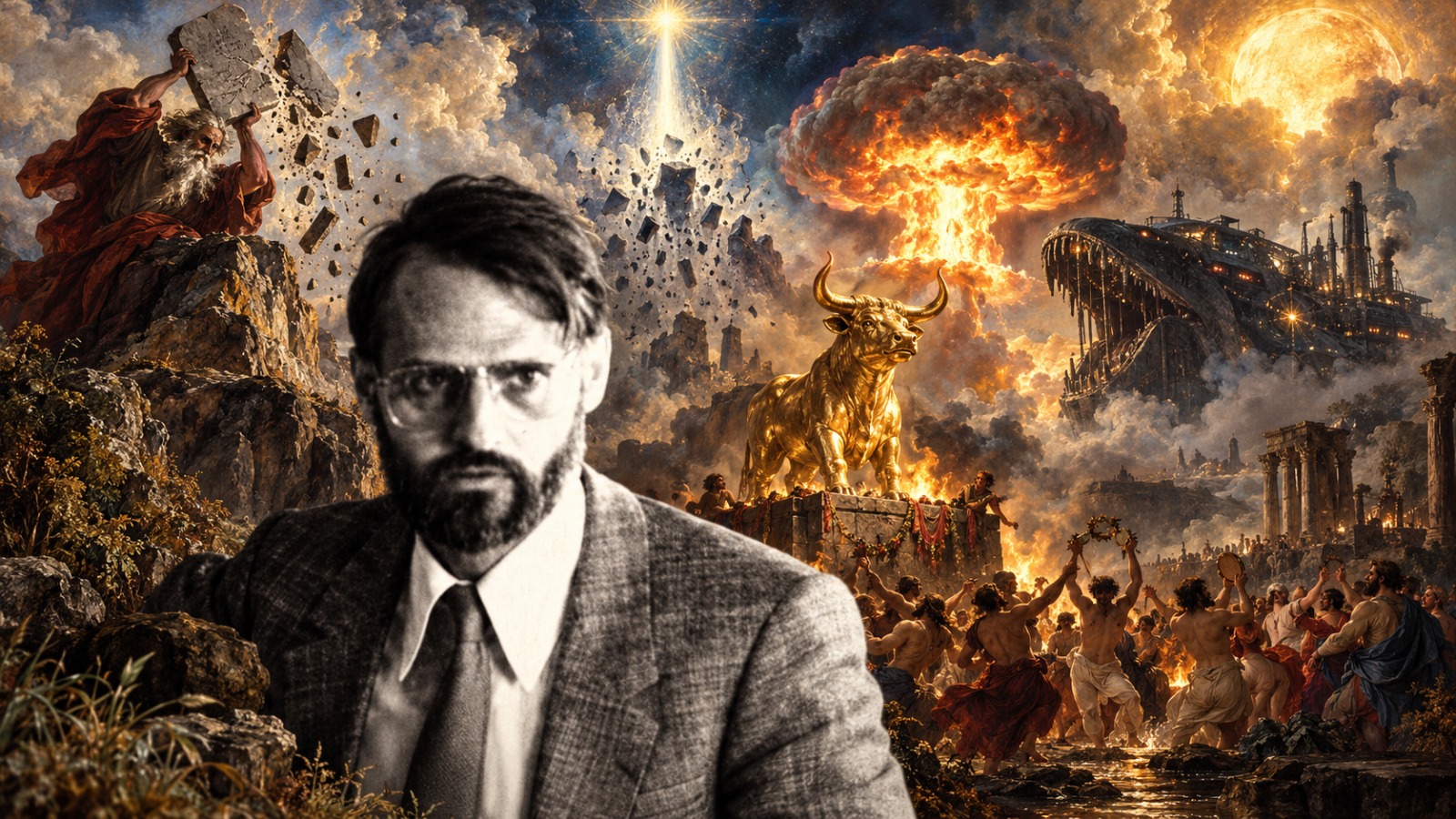
For a taste of Giegerich’s thinking, there is a recorded lecture given at an event hosted by the C.G. Jung Institute of Chicago. His host introduces him as a provocateur, and the lecture lives up to it. Giegerich takes on the nuclear bomb, and argues that to see it properly we must step back to the right distance, as with a painting. He reads the Old Testament story of the golden calf as a split within God, who withdraws from his visible, animal image to become invisible spirit while the physical world is left as mere matter. He calls this the first nuclear fission, a splitting of the image itself, and he sees the bomb as the return of the reality that was cast off. His conclusion is that “the nuclear bomb is God”, not as a literal statement but as an image of absolute terror, and he ends with a vivid picture of a humanity that dances around its golden calf. It is dense and demanding listening, and a good example of his philosophical, image-centred way of thinking.
A conference in Taipei
The Society is also hosting a conference this December with the Department of Family Studies and Child Development at Shih Chien University. The 2026 International Conference on Jungian Psychology and Family Mental Health takes place in Taipei on Saturday 12 and Sunday 13 December 2026. Its theme is “Asian Women: Jungian Perspectives”, with Jungian analysts and social scholars from the United States, the United Kingdom, Denmark, Japan, China and Taiwan. They will explore the psychological bonds of Asian women within families across generations, and their individuation from youth through middle age to later life. The conference also takes in the whole life course, starting from the cultural complexes of Asian women and looking at the mental health of families of all ages.