
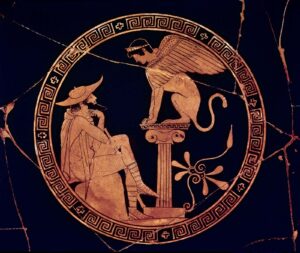
By the time of Homer’s Odyssey, where we find the first mention of Oedipus, the myth was already ancient, reaching into prehistory. Sophocles’ play Oedipus Tyrannus was first performed in Athens shortly after the plague years of 430-426 BCE, in which more than a quarter of its inhabitants died, leading to its defeat by Sparta and ending its status as a superpower in Ancient Greece. The play opens with the inhabitants of Thebes begging King Oedipus for aid in understanding and curing the plague. The play thus has special relevance for our time. 2,300 years later, the myth of Oedipus emerged as a “childhood dream” of psychoanalysis, recounting the ancestral crimes of infanticide, parricide, and incest that assisted in creating our age, rendering us unconscious of our archetypal origins, and living them out as fate. Sophocles’ last play, Oedipus at Colonus, shows us the path of the hero as initiate, and parallels Jung’s journey of initiation as recorded in The Red Book. Oedipus and Jung offer us a path into a new age, hinted at in the Orphic cosmogonies and envisioned by Jung as the “Age of the Holy Spirit.”
Saturday’s workshop will go deeper into how the myth of Oedipus shaped the origins and development of psychoanalysis and analytical psychology, and the parallels between Oeidpus’ initiation and Jung’s.
