
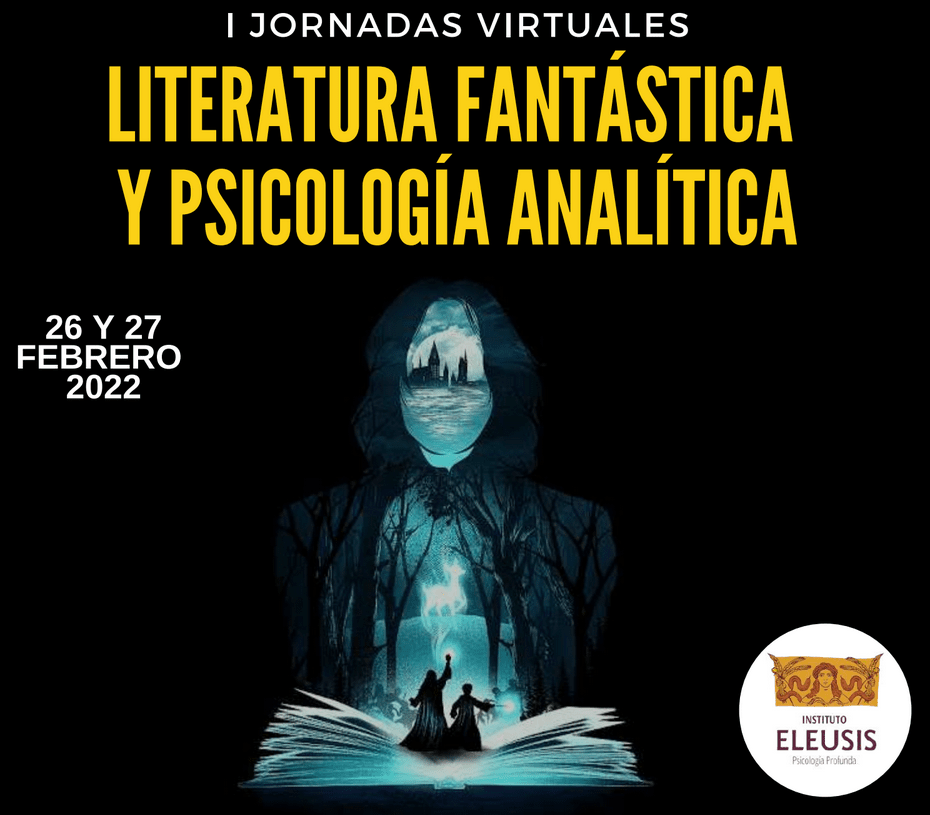
El INSTITUTO ELEUSIS organizará cada año, desde Febrero 2022 un evento dedicado a explorar las relaciones entre la Literatura Fantástica y la Psicología Analítica de Carl Gustav Jung. La Literatura fantástica es un género complejo en el cuál los límites racionales entre lo real e imaginario se diluyen, el mundo ordinario es inundado por el amplio espacio de lo maravilloso, lo numinoso, lo terrible, lo mágico, lo improbable y lo inexplicable.
La Literatura Fantástica es un vasto campo de expresión de la función creativa de la psique, del mundo simbólico y de representación de diversas imágenes arquetípicas y motivos existenciales: “La imagen primigenia o arquetipo es una figura que, ya sea “demon” , hombre o proceso, se repite a lo largo de la historia allí donde se ejerce libremente la fantasía creadora” (Jung. Oc. 15) Para Jung, es posible comprender el Alma a través de sus diversas expresiones personales y culturales. Para Carl Gustav Jung, la psique es básicamente creativa y su lenguaje se manifiesta en imágenes y símbolos de carácter arquetipal, es decir, en patrones compartidos de comportamiento, que se expresan en la mitología y el arte, así como en los sueños o fantasías personales: “Cada una de estas imágenes encierra un fragmento de psicología y de destino humano, una porción de dolor y de placer que se han experimentado indecibles veces en la cadena de nuestros ancestros” (Jung. Oc. 15)
Joseph Campbell en su monumental obra “Las Máscaras de Dios. Tomo IV. Mitología Creativa” sostiene que la capacidad creativa fue durante siglos capturada y encriptada por instituciones religiosas, posteriormente esta función fue menospreciada por la razón; sin embargo existe en el alma humana una conexión profunda y primigenia con la dimensión simbólica, fantástica y creativa: “Los símbolos mitológicos tocan y excitan centros vitales que están fuera del alcance de los vocabularios de la razón y la coerción”.
Algunos autores de la Literatura Fantástica que exploraremos en estos ciclos son: Dante, Poe, Hoffmann, Cazotte, Stevenson, Gray, Baum, Carrol, Shelley, Stoker, Tolkien, Matthew Barrie, Le Guin, Martin, Rowling, Baum, Lewis, Salgari, Melville, Kafka, Herbert, Rice, Asimov, Borges, Lovecraft, King, Sanderson, Ende, Howard, Bodoc, entre muchos otros autores. Este espacio está dirigido a todos los amantes de la Literatura Fantástica y la Psicología Analítica Junguiana.
SÁBADO
09h00 – 10h30 | Mesa de Apertura: La Literatura Fantástica y la Psicología Analítica de Carl Gustav Jung
11h00 – 12h30 | Los distintos planos del cosmos, o la complejidad psíquica: Dante y la Divina Comedia.
14h00 – 15h30 | La simbolismo del Dragón en los mitos y su influencia en la Literatura Fantástica
16h00 – 17h00 | H.P. Lovecraft: El terror de lo innombrable
17h00 – 18h00 | Simbolismo del Gato Negro de Allan Poe
18h30 – 19h30 | “El Retrato de Dorian Gray” de Oscar Wilde
19h30 – 20h30 | Análisis de Drácula de Bram Stoker
21h00 – 22h00 | La Bella Durmiente de Sheri Tepper
DOMINGO
09h00 – 10h30 | Lo Simbólico Fantástico en la Saga de los Confines Homenaje a Liliana Bodoc
11h00 – 12h30 | Jorge Luis Borges y Silvina Ocampo
14h00 – 15h30 | Historias de Cronopios y de Famas de Julio Cortázar
16h00 – 17h00 | La Sicigia Ánima-Ánimus en el relato de “Beren y Lúthien” de J.R.R. Tolkien
17h00 – 18h00 | El proceso de Individuación de Gavilán en “Un Mago de Terramar” de Úrsula K. Le Guin
18h30 – 19h30 | La Mujer Desnuda de Armonia Somers
19h30 – 20h30 | Alicia a través del espejo (de la Psicología Analítica de Carl Gustav Jung)
21h00 – 22h00 | Análisis Junguiano de “El Principito” de Antoine de Saint-Exupéry
– – – – – – – – – – – – – – – – – – – – – – – – – – – – – – – – – – – – – – – – – – – – – – – – – – – – – – – – – – – – – – – – – – – – – – – – – – – – – – – – – – – – – – – –
The ELEUSIS INSTITUTE will organize every year, from February 2022, an event dedicated to exploring the relationship between Fantastic Literature and Carl Gustav Jung’s Analytical Psychology. Fantastic literature is a complex genre in which the rational limits between the real and the imaginary are diluted, the ordinary world is flooded by the wide space of the wonderful, the numinous, the terrible, the magical, the improbable and the inexplicable.
Fantastic Literature is a vast field of expression of the creative function of the psyche, of the symbolic world and of representation of various archetypal images and existential motifs: “The original image or archetype is a figure that, whether it is a demon, man or process, is repeated throughout history where creative fantasy is freely exercised” (Jung. Oc. 15) For Jung, it is possible to understand the Soul through its various personal and cultural expressions. For Carl Gustav Jung, the psyche is basically creative and its language is manifested in images and symbols of an archetypal nature, that is, in shared patterns of behavior, which are expressed in mythology and art, as well as in dreams or personal fantasies. : “Each of these images contains a fragment of psychology and human destiny, a portion of pain and pleasure that have been experienced countless times in the chain of our ancestors” (Jung. Oc. 15)
Joseph Campbell in his monumental work “The Masks of God. Volume IV. Creative Mythology” maintains that the creative capacity was for centuries captured and encrypted by religious institutions, later this function was underestimated by reason; however, there is in the human soul a deep and primordial connection with the symbolic, fantastic and creative dimension: “Mythological symbols touch and excite vital centers that are beyond the reach of the vocabularies of reason and coercion.”
Some authors of Fantastic Literature that we will explore in these cycles are: Dante, Poe, Hoffmann, Cazotte, Stevenson, Gray, Baum, Carrol, Shelley, Stoker, Tolkien, Matthew Barrie, Le Guin, Martin, Rowling, Baum, Lewis, Salgari , Melville, Kafka, Herbert, Rice, Asimov, Borges, Lovecraft, King, Sanderson, Ende, Howard, Bodoc, among many other authors. This space is aimed at all lovers of Fantastic Literature and Jungian Analytical Psychology.
SATURDAY
9:00 a.m. – 10:30 a.m. | Opening Table: The Fantastic Literature and Analytical Psychology of Carl Gustav Jung
11:00 a.m. – 12:30 p.m. | The different planes of the cosmos, or psychic complexity: Dante and the Divine Comedy.
2:00 p.m. – 3:30 p.m. | The symbolism of the Dragon in myths and its influence on Fantastic Literature
4:00 p.m. – 5:00 p.m. | H.P. Lovecraft: Terror of the Unspeakable
5:00 p.m. – 6:00 p.m. | Allan Poe’s Black Cat Symbolism
6:30 p.m. – 7:30 p.m. | “The Picture of Dorian Gray” by Oscar Wilde
7:30 p.m. – 8:30 p.m. | Analysis of Bram Stoker’s Dracula 9:00 p.m. – 10:00 p.m. | Sleeping Beauty by Sheri Tepper
SUNDAY
9:00 a.m. – 10:30 a.m. | The Symbolic Fantastic in the Saga of the Confines Tribute to Liliana Bodoc
11:00 a.m. – 12:30 p.m. | Jorge Luis Borges and Silvina Ocampo
2:00 p.m. – 3:30 p.m. | Stories of Cronopios and Famas of Julio Cortázar
4:00 p.m. – 5:00 p.m. | The Ánima-Ánimus Syzygy in the story of “Beren and Lúthien” by J.R.R. Tolkien
5:00 p.m. – 6:00 p.m. | The Sparrowhawk Individuation process in “A Wizard of Earthsea” by Úrsula K. Le Guin
6:30 p.m. – 7:30 p.m. | The Naked Woman by Armonia Somers
7:30 p.m. – 8:30 p.m. | Alice Through the Looking Glass (from Carl Gustav Jung’s Analytical Psychology)
9:00 p.m. – 10:00 p.m. | Jungian Analysis of “The Little Prince” by Antoine de Saint-Exupéry