
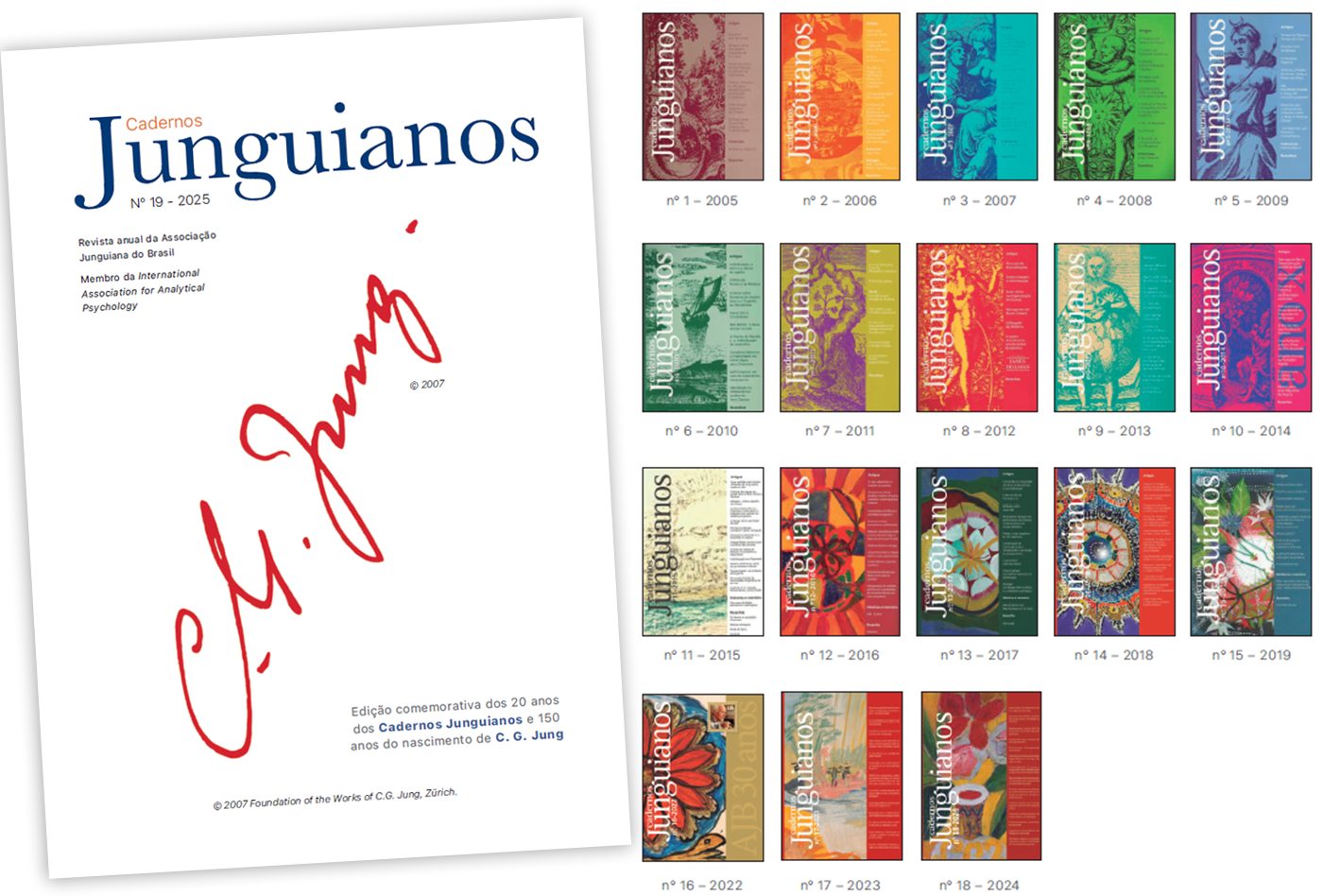
Cadernos Junguianos Vol 19 (2025) is now available to download as a PDF (full issue free of charge). The 2025 expanded issue celebrates Jung’s 150th birthday and the journal’s own 20-year legacy with a provocative exploration of the relevance analytical psychology to 21st-century challenges
From Historical Figures to Digital Shadows
Editors issued an ambitious call for papers asking contributors to explore Jung’s legacy through multiple lenses: direct tributes to his life and work, contemporary applications of his theories, expansions of Jungian thought, and interdisciplinary dialogues spanning social sciences, religion, and the arts. The goal? To position analytical psychology as an “avant-garde science” capable of addressing what the editors call the “contemporary complexity” of our century.
The volume opens with historical recovery work that challenges long-held narratives. Idalina A. de Souza examines Emma Jung’s “almost invisible” but foundational contributions to analytical psychology, arguing that she provided not only emotional support but original theoretical work on the Grail myth and the animus concept.
Similarly, Armando de Oliveira e Silva and Pedro Henrique Alberton Perússolo work to rescue Toni Wolff from her relegation as Jung’s “muse,” presenting systematic translations and critical analysis that establish her as a “silent builder of foundations” for complex psychology. The historical section also explores the paradigm-shifting correspondence between Jung and physicist Wolfgang Pauli on the intersection of psyche and matter.
Technology, Race, and the Shadow Side of Progress
But the journal doesn’t stay in the archives. Several articles tackle urgent contemporary issues through a Jungian lens.
Magno da Silva Parmagnani analyzes social media through the concepts of persona and shadow, arguing that the “digital panopticon” of algorithms exploits human needs for approval while forcing users to repress their shadows—leading to what he identifies as collective suffering and “online hatred.”
Paulo Priori takes on artificial intelligence through the Prometheus myth, suggesting that AI represents a new “theft of fire” expanding human capability. But he warns against “psychic petrification”—the danger of treating these tools as merely inanimate objects rather than reflections of the anima mundi. He advocates for what he calls a “borderline relationship” with technology that preserves symbolic exchange between creator and creation.
Confronting Whiteness and Structural Racism
The volume’s most challenging material may be its unflinching examination of race and clinical practice. Bruno Correia da Mota explores the “symbolic cultural space of the quilombo” (communities founded by escaped enslaved Africans) as a form of resistance within the Black psyche, calling for an “aquilombamento” of clinical practice—embedding anti-racist awareness into therapeutic work.
Raíssa Völker goes further, directly challenging what she calls the “whiteness” of analytical psychology itself. She demands that analysts confront their own racial privileges and abandon what she terms the “delusion of neutrality” in the consulting room.
Ezequiel Nogueira Braga contributes work on using Jungian approaches with incarcerated youth, arguing that in institutional settings “where the word fails,” symbolic listening becomes both radical care and political resistance.
A Living Tradition
The editors frame Volume 19 as evidence that Brazilian Jungian scholarship remains vibrant and engaged with the “spirit of the times.” By bridging ancient philosophy and modern crises—from climate change to AI ethics—the journal fulfills its stated mission as a “permanent forum” for collective reflection.
The volume’s breadth suggests that for these analysts, individuation is not merely a private psychological journey but an ethical imperative with social dimensions. As Brazil’s analytical psychology community enters its next decade, Cadernos Junguianos positions itself as both guardian of Jung’s legacy and laboratory for its evolution. The full back catalogue of the journal can be downloaded from the AJB website. Although the journal is published in Portuguese with modern AI tools the texts are easily accessible in any language.