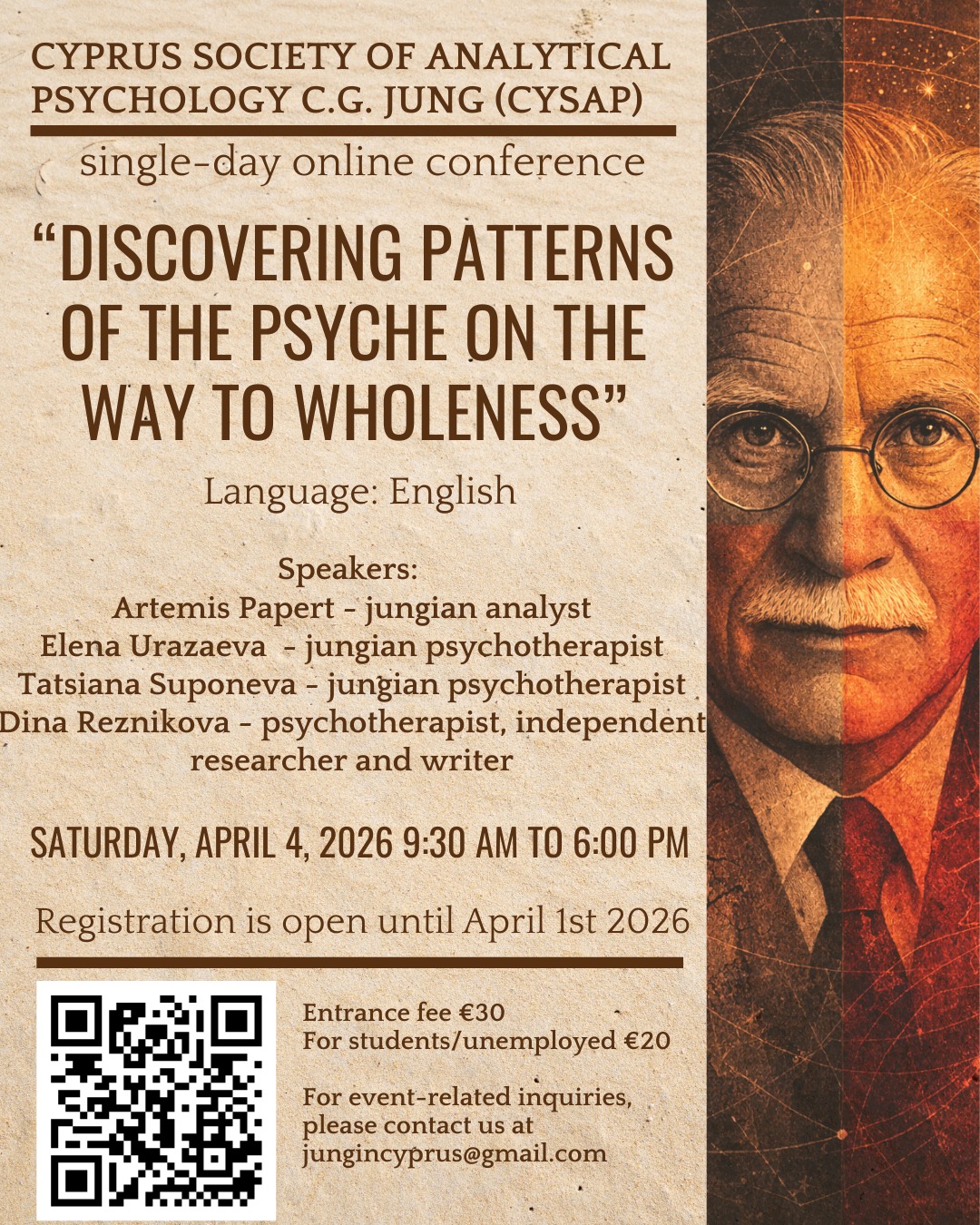
“For complete orientation all four functions should contribute equally; thinking should facilitate cognition, feeling
should tell us the value of things, sensation should convey concrete reality, and intuition should indicate the possibilities.”– C.G. Jung
Conference Program
09:30 – 10:00 | Welcoming Message – Ιntroductions
10:00 – 11:00 |Introduction to the enneagram alongside Jungian therapy
Speaker: Dina Reznikova, psychotherapist, independent researcher, writer
11:30 – 12:30 | The Fourfold Path to Wholeness: King, Warrior, Magician, Lover as Archetypal Framework for
Integration Speaker: Tatsiana Suponeva, Jungian psychotherapist
13:00 – 14:30 | Lunch Break
14:30 – 15:30 | Encountering the Inferior Function in Psychotherapy: When the Weakest Becomes the Strongest
Speaker: Elena Urazaeva, Jungian psychotherapist
16:00 – 17:00 | Jungian Typology (or How I Saved My Sanity) Speaker: Artemis Papert, Jungian Analyst
17:30 – 18:00 | Closing Reflections & Farewell
Notes:
After every lecture there will be a 15 minute Q&A followed by a 15-minute break. All lectures will be presented in English.
Presentations:
Introduction to the enneagram alongside Jungian therapy | Dina Reznikova
The Enneagram is a personality typology describing nine fundamental patterns through which individuals organize perception, motivation, and relational behavior. Integrating elements of developmental psychology, defense mechanisms, and unconscious motivation, the model offers a dynamic framework for understanding personality structure that can complement existing psychological approaches.
This lecture introduces psychologists to the basic architecture of the Enneagram: the nine personality types, their core fears and desires, characteristic defenses, and typical relational strategies. Particular attention will be given to how these patterns manifest in clinical settings and everyday interpersonal dynamics.
One aspect briefly explored will be countertransference patterns that different types may evoke in therapists—for example, rescue impulses with Type Two, irritation with Type One, intellectualization with Type Five, or confrontation dynamics with Type Eight. Recognizing these reactions can help clinicians distinguish their own responses from the client’s personality structure.
The lecture aims to provide a clear introductory map of the Enneagram and its potential usefulness for psychological observation and clinical reflection.
The Fourfold Path to Wholeness: King, Warrior, Magician, Lover as Archetypal Framework for Integration | Tatsiana Suponeva
This presentation introduces Robert Moore’s neo-Jungian model of the psyche, which identifies four fundamental archetypal energies — King, Warrior, Magician, and Lover — as structural elements underlying psychological wholeness. We will explore each archetype in its fullness and shadow manifestations, examine how this quaternary model relates to Jung’s typological framework, and consider its implications for understanding both healthy development and psychopathology. The session will include an opportunity for self-reflection on participants’ own archetypal landscape.
Encountering the Inferior Function in Psychotherapy: When the Weakest Becomes the Strongest | Elena Urazaeva
This presentation explores the Jungian concept of the inferior function and its role in psychological development and clinical work. While the dominant function structures conscious adaptation, the inferior function remains less differentiated, emotionally charged, and largely unconscious. Yet it carries transformative potential. After a brief theoretical overview of typology, I will illustrate through clinical vignettes how the inferior function if neglected may erupt: in partners or lovers who carry what we cannot bear in ourselves, in quarrels charged with disproportionate emotion, in dreams of engulfing waves or consuming fire, especially for those who trust thinking more than feeling. The talk highlights the therapeutic process of recognizing, containing, and building a dialogue with the unconscious through the inferior function, facilitating these essential for individuation processes. Clinical reflections will focus on how the analytic relationship can provide a containing space in which this fragile yet powerful aspect of the psyche can emerge safely. To encounter the inferior function is to approach the edge of ego certainty and to discover there the possibility of renewal. It is not merely a disruption of ego stability, but a necessary movement toward psychic wholeness.
Jungian Typology (or How I Saved My Sanity) | ARTEMIS PAPERT
Common culture has popularised the terms ‘extravert’ and ‘introvert’. However not many people know that it is the Swiss psychologist C.G.Jung who first recognised introversion and extroversion as the two fundamental psychological attitudes. Jung also described the four psychological functions of Intuition, Sensation, Feeling and Thinking. Personality tests like the MBTI (Myers-Briggs Type Indicator), often used in the corporate world, are based on Jung’s theory of psychological types. Jung said “The four functions are somewhat like the four points of the compass; they are just as arbitrary and just as indispensable. But one thing I must confess: I would not for anything dispense with this compass on my psychological voyages of discovery.”
In this presentation we will explore Jung’s psychological types and how they influences the way we interact with others and the world.