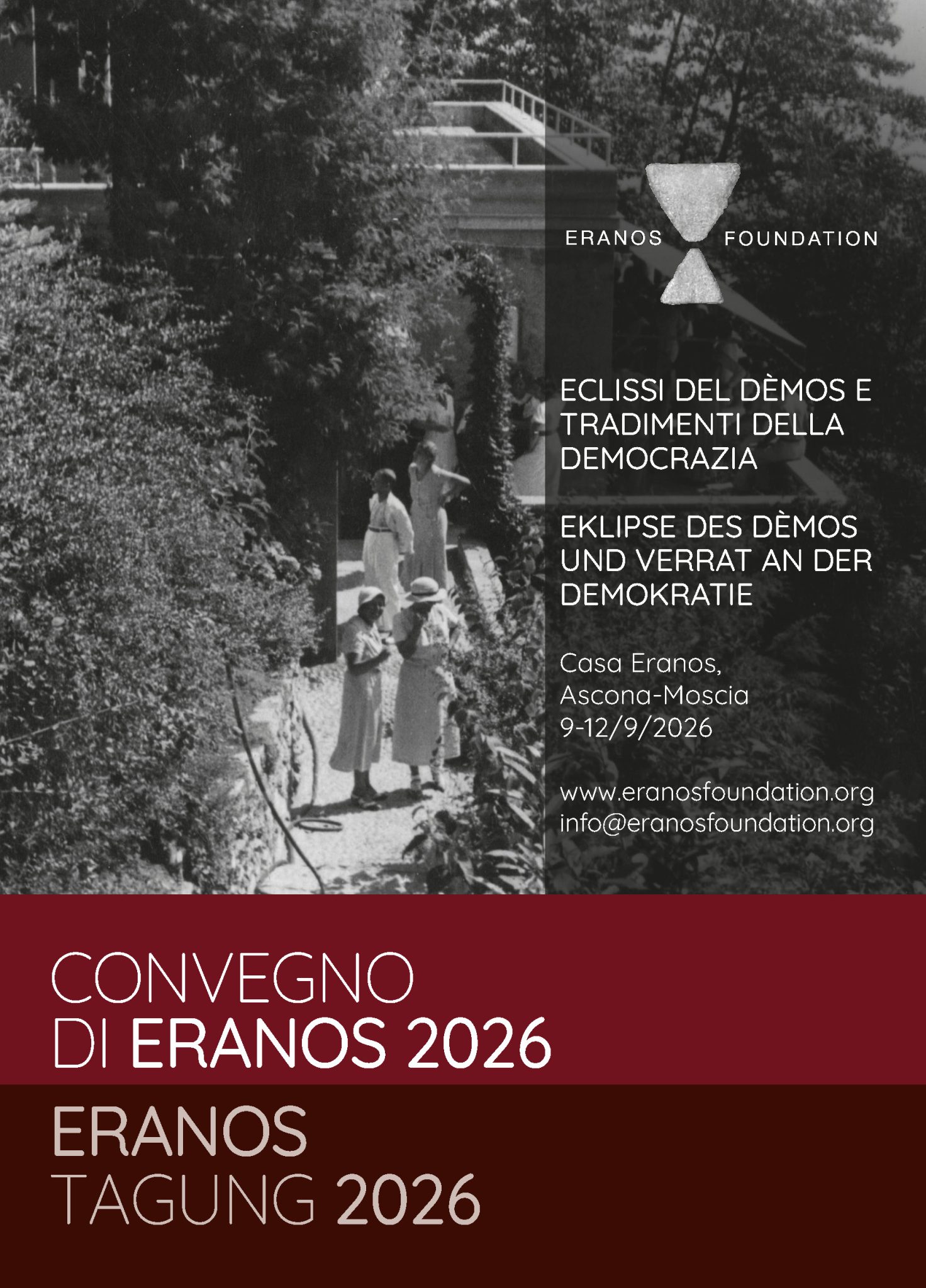
A society that makes immediacy its main ally, to the extent that it defines as ‘real’ that time which asserts itself by cancelling itself out, is a society that believes it can do without all those intermediary structures where the creation of value (economic, social, individual) emerges through the diachronic dimension of duration, rather than through the synchronic dimension of instantaneity. In such a context, the question arises as to what conception of dèmos can still be plausible and whether it is still possible to speak of ‘people’ in a strictly political sense. Can there still be humanitas (the term used to refer to solidarity, justice, equality, recognition, and therefore inclusiveness) where the individualism of our societies seems only capable of paying attention to the needs of particularity? And without humanitas, can there still be a dèmos as ideally conceived by modern democracies? And again: if it is really impossible to do without it, is there a way of thinking about particularity without having to renounce universality? Without, therefore, giving in to the regressive and exclusivist tendencies of éthnos?
Today’s crisis of democracy reflects the rise of identity claims where the reasons for division take precedence over those of cohesion and mutual responsibility. But where a society loses its sense of community, what idea of démos can still survive? Of course, there are good reasons to explain this drift. The vulnerability of democracy requires constant maintenance. Its values either find a way to be embodied in our practices of life or remain empty simulacra. That is, they cannot survive in the realm of ideas alone. They need to find the space and resources to be acted upon on a daily basis. In the absence of this, there is only resentment, aggression, and conflict. All this is now commonplace at various levels of social life: just think of the impasse in which work has ended up, where the constant demand for increased performance is matched by a steadily declining capacity for representation, with all the effects of fragility and resentment that this entails. In this scenario, what is at stake is not simply the stability of formal institutions, but the very possibility of rebuilding a shared horizon of meaning, in which the démos does not coincide with either the sum of self-referential individuals or the identity-based retreat of the éthnos.
If democracy wants to escape the logic of instantaneity and the fragmentation that comes with it, it must return to investing in the long term of practices, relationships, and mediations, where universality does not erase particularity but makes it intelligible and communicable. Humanitas, then, cannot be thought of as a moral residue of an idealized past, but rather as an ever-unfinished political task that requires places, times, and devices capable of sustaining the experience of reciprocity and mutual responsibility. Only in this perspective can the demos regain depth, not as an immediate given or a closed identity, but as a fragile and continuously exposed historical construction, which thrives on the daily care of its bonds and the ability to recognise, in conflict itself, a possibility for cohesion and a shared future.
Please note that the Conference has limited places. For this reason, advanced registration is required, by email, info@eranosfoundation.org
