
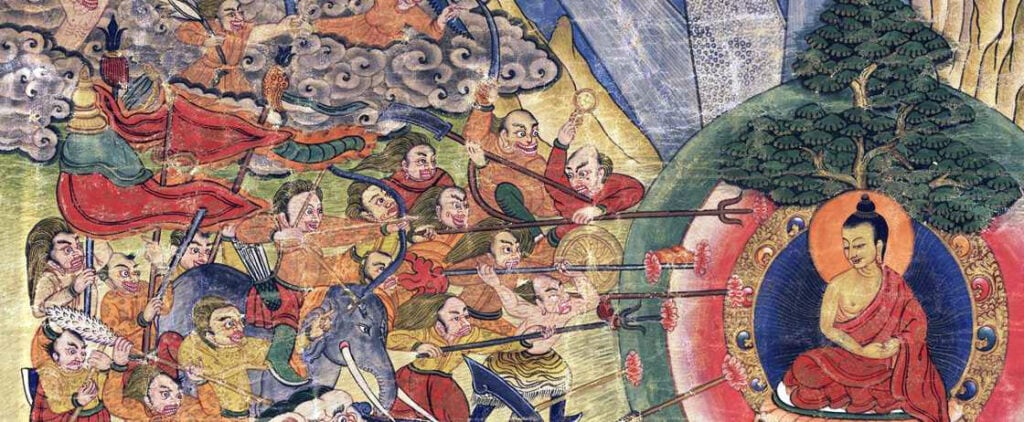
Nel seminario ci concentriamo principalmente sugli aspetti psicologici e storico-religiosi dello sviluppo della figura di Māra nell’ambito del Buddhismo. Il percorso seminariale prevedrà lo studio di testi e immagini dalle tradizioni sapienziali del Buddhismo primitivo, del Buddhismo Mahāyāna e del Tantrismo. Se nel Buddhismo primitivo l’enfasi era riposta sul riconoscimento di situazioni e stati mentali pericolosi associati alla figura di Māra, vedremo come, sotto l’influenza della compassione e della saggezza proprie del Buddhismo Mahāyāna, si assista allo sviluppo di modelli che prevedono una integrazione e, infine, una liberazione del principio spirituale rappresentato da Māra. In un testo importante del Buddhismo Mahayana, è addirittura predetto che Māra divenga egli stesso Buddha. Nel Tantra ritroviamo Māra nelle forme irate del Buddha, dove si assiste alla trasformazione delle energie di Māra in una azione liberatoria e compassionevole che integra tali aspetti iracondi. Tracceremo quindi parallelismi tra la figura di Māra e quella di Satana, come testimoniata nell’Antico e nel Nuovo Testamento, recuperando altresì riferimenti delle rappresentazioni del Diavolo nella storia dell’arte antica e moderna. Noteremo come un certo paradigma tenda all’opposizione e, in alcuni testi, a una vera e propria dissociazione tra Dio e Diavolo, bene e male: una situazione che segue a una iniziale mancanza di chiarezza tra l’azione onnipotente dello Jahvè veterotestamentario, che si può anche esprimere nelle attività dello stesso Satana (come documentato, in modo emblematico, nel Libro di Giobbe), e la rappresentazione di Satana come avversario di Dio.
Comprendendo Māra e Satana come manifestazioni del male o, nel lessico della Psicologia Analitica, dell’archetipo dell’Ombra, approfondiremo infine come Carl Gustav Jung si sia occupato di questo tema nell’ambito della sua più ampia riflessione sulla psicologia della religione. In modo congruente con l’impostazione buddhista, infatti, Jung mostra come, attraverso il simbolismo della quaternità, l’immagine cristiana di Dio tenda all’integrazione – e non alla divisione o addirittura alla dissociazione – di bene e male, luce e ombra. Il seminario, riservato a Studenti di Psicologia, Psicologi, Specializzandi in Psicoterapia e Psicoterapeuti, affiancherà alle considerazioni teoriche anche sessioni a carattere esperienziale, con momenti di consapevolezza meditativa, ascolto ed espressione spontanea del corpo e attività di disegno libero, al fine di esplorare la risonanza personale dei temi trattati e delle immagini utilizzate.
– – – – – – – – – – – – – – – – – – – – – – – – – – – – – – – – – – – – – – – – – – – – – – – – – – – – – – – – – – – – – – – – – – – – – – – – – – – – – – – – – – – – – – – – – – – –
Archetypal Shapes of the Shadow: Māra in Buddhism and Satan in Christianity in the light of Analytical Psychology
In the seminar we mainly focus on the psychological and historical-religious aspects of the development of the figure of Māra in the context of Buddhism. The seminar will include the study of texts and images from the sapiential traditions of primitive Buddhism, Mahāyāna Buddhism and Tantrism. If in primitive Buddhism the emphasis was placed on the recognition of dangerous situations and mental states associated with the figure of Māra, we will see how, under the influence of the compassion and wisdom of Mahāyāna Buddhism, we witness the development of models that foresee an integration and finally, a release of the spiritual principle represented by Māra. In an important text of Mahayana Buddhism, it is even predicted that Māra will become Buddha himself. In Tantra we find Māra in the wrathful forms of the Buddha, where we witness the transformation of the energies of Māra into a liberating and compassionate action that integrates these angry aspects. We will therefore draw parallels between the figure of Māra and that of Satan, as witnessed in the Old and New Testament, also recovering references to the representations of the Devil in the history of ancient and modern art. We will notice how a certain paradigm tends to opposition and, in some texts, to a real dissociation between God and Devil, good and evil: a situation that follows an initial lack of clarity between the omnipotent action of the Old Testament Yahweh, who it can also be expressed in the activities of Satan himself (as documented, in an emblematic way, in as testified in the Old and New Testament, also recovering references of the representations of the Devil in the history of ancient and modern art. We will notice how a certain paradigm tends to opposition and, in some texts, to a real dissociation between God and Devil, good and evil: a situation that follows an initial lack of clarity between the omnipotent action of the Old Testament Yahweh, who it can also be expressed in the activities of Satan himself (as documented, in an emblematic way, in as testified in the Old and New Testament, also recovering references of the representations of the Devil in the history of ancient and modern art.
We will notice how a certain paradigm tends to opposition and, in some texts, to a real dissociation between God and Devil, good and evil: a situation that follows an initial lack of clarity between the omnipotent action of the Old Testament Yahweh, who it can also be expressed in the activities of Satan himself (as documented, in an emblematic way, inBook of Job), and the representation of Satan as an adversary of God. Understanding Māra and Satan as manifestations of evil or, in the lexicon of Analytical Psychology, of the archetype of the Shadow, we will finally deepen how Carl Gustav Jung dealt with this theme in the context of his broader reflection on the psychology of religion. In a way that is congruent with the Buddhist approach, in fact, Jung shows how, through the symbolism of quaternity, the Christian image of God tends to the integration – and not to the division or even to the dissociation – of good and evil, light and shadow. The seminar, reserved for Psychology Students, Psychologists, Psychotherapy Specialists and Psychotherapists, will combine the theoretical considerations with experiential sessions, with moments of meditative awareness.