
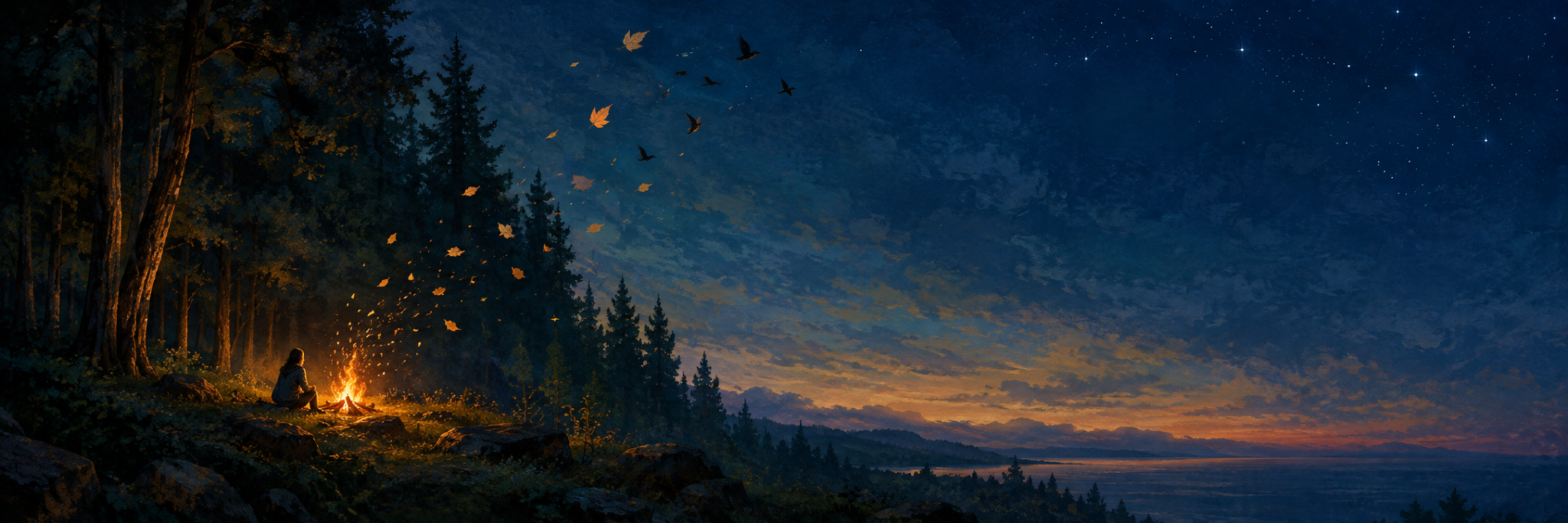
The day is over, the sun sinks below the horizon, beginning its journey through the underworld. The sky turns orange, then violet, and the first stars come out. Under the trees the dark has already gathered itself, thick and quiet, and somewhere in it a branch cracks. The certainty of consciousness softens, and the figures of the imagination emerge emboldened. Someone feeds a few sticks to the fire, which flares and settles into a steady glow, and the people sitting around it move a little closer to each other without quite deciding to. Nobody speaks for a while. Then a voice begins, low and unhurried: “Once upon a time, there was a woodcutter who had two sons…”
The dark does not go away, but it changes. Beyond the firelight the forest is still full of things nobody can see, and now it is also full of a woodcutter and his sons, a talking fox, a door that should not be opened. The listeners have gone into the forest after all, and they have gone with company and a light. People have been doing this for as long as there have been fires, and Jungians have never been in any doubt about why it works. The forest at the edge of the firelight is the unconscious, and fairy tales are the oldest map we have of what goes on in there. They have been part of analytical psychology since its earliest days. This autumn there are more ways than usual to hear them, study them and read them, with two live storytelling events, a good deal on demand, and some essential reading for the Jungian library.
Great Storytellers
There was once a king named Shahryar, who was betrayed by his wife and swore it would never happen to him again. Every evening he married a new bride, and every dawn he had her put to death. Then it was the turn of the vizier’s daughter, Scheherazade, who brought no weapon, only a story. She began it that night and stopped at the most suspenseful moment, and the king, desperate to know what happened next, let her live one more day. So it went for a thousand and one nights, until the king had fallen in love with his storyteller and forgotten his vow. It is the scene at the campfire moved to a palace: a listener afraid of the dark, a teller who keeps it at bay, and a story that never quite finishes.
Her tales had travelled a long way to reach her, from India and Persia to Arabia and Egypt, and they travelled further still when Antoine Galland carried them to Paris in the early 1700s, helped by a Syrian storyteller named Hanna Diyab who supplied Aladdin and Ali Baba from memory.
Two writers stand behind the Western fairy tale tradition, and neither set out to write for children. Jacob and Wilhelm Grimm were scholars who believed that folk tales held the soul of a nation, and they went about gathering them with a philologist’s zeal. The first volume of their Children’s and Household Tales appeared in 1812, full of footnotes and promptly criticised as unsuitable for children. The brothers kept revising it for the rest of their lives, and along the way a wicked mother in Snow White became a wicked stepmother. They also began a monumental German dictionary, which they took as far as the word Frucht (fruit). It must be the only dictionary whose authors both died before reaching a fruit.
Hans Christian Andersen did not collect tales. He made his own. He was born poor in Denmark, the son of an illiterate washerwoman and a father who read him The Arabian Nights, and at fourteen he set off for Copenhagen to seek his fortune. Where the Grimms gathered, Andersen took the old stories as a starting point and wove in pieces of his own life. He went on to write more than 160 tales, from the hopeful Snow Queen to the heartbreaking Little Match Girl, and he insisted they were “for all ages”. He was also famously sensitive to criticism, which is a hazard of the trade.
The woman who took the tales seriously
No one did more to make fairy tales a Jungian subject than Marie-Louise von Franz (1915–1998). She met Jung at eighteen, called it the most decisive encounter of her life, entered analysis with him soon afterwards, and worked alongside him until his death in 1961.
Her way into fairy tales was an assignment. In 1935 Hedwig von Beit asked her to help part-time with a book on the subject. The side project became nine years of research and interpretation, and the result was the three-volume Symbolik des Märchens. It appeared under von Beit’s name alone, though von Franz did the heavy lifting. The experience convinced her that fairy tales are psychological documents, and her later books followed: The Interpretation of Fairy Tales, Shadow and Evil in Fairy Tales and The Feminine in Fairy Tales.
She saw these stories as the purest and simplest expression of collective unconscious processes, with archetypes in their barest form, and her readings tended to surprise. On how to deal with evil she concluded that there is no single rule: sometimes you fight, sometimes you use your wits, sometimes you work magic, and sometimes you retreat. The only constant is to rely on the innermost Self. She read the despised third son, the “dummling”, as the inferior function, the ever-bleeding wound through which the unconscious breaks into consciousness.
She was a formidable lecturer, and Murray Stein remembered listening to her as a numinous experience, saying he thought God was speaking. In her last years, as Parkinsonism advanced, she dreamed that she had become the new apprentice postman at the Bollingen post office, charged with delivering Jung’s work on synchronicity and number to a new generation. She refused strong pain medication to keep her mind clear for the task. She delivered the post to the end, with the tales in her mailbag.
Two Storytellers, Two Archetypal Journeys
This season, two storytellers bring fairy tales to Jungian audiences, each exploring a classic Grimm tale.
On Thursday 5 November 2026, storyteller Jo Blake tells The Two Brothers at the C.G. Jung Club London. In 1913/14, Emma Jung chose this very tale as the subject of her thesis for formal membership in the newly founded Association of Analytical Psychology. She did so a year after Freud had written to Jung about the same motif, and the “weaker brother” in particular. Blake’s retelling follows the twists of an epic adventure, with sibling rivalry, love, loyalty, deadly misunderstandings, and a host of animal companions. Blake works across dance, theatre, and therapeutic settings, holds a PhD in Emergent Storytelling Practice from the University of Chichester, and is co-founder of the Anima Mundi School of Storytelling. The evening begins at 7pm for 7.30pm at Essex Church and is also available on Zoom. The in-person portion of the event will be followed by the Club’s winter party with drinks and nibbles. You can click here to register.
Then, on Friday 4 December 2026, from 7 to 9pm Eastern Time, the Jung Association of Western Massachusetts presents performance storyteller Jay Leeming in “Entering the Forest”, an exploration of the Grimms’ The Water of Life. In this tale, three princes set out to find a cure for their dying father, and their rivalry shapes the journey. It is a story that can help us find new ways forward when we feel locked in a world of stone. Leeming performs it in the traditional way, with improvised language and the accompaniment of guitar and drum, and there is time throughout for the group to explore the tale. Participants are asked to bring a notebook as well as their dreaming hearts. Leeming is the creator of the Crane Bag podcast , which is free to listen to. Its archive of stories is sorted into categories, ranging from wonder tales and epics to creation myths and explorations of poems. Episodes include Rapunzel, Sleeping Beauty, The Handless Maiden, Gilgamesh, and The Odyssey, and The Water of Life is among them too. You can register for this event here.
Further resources on Fairytales
There is more for fairy tale lovers to explore. The Assisi Institute’s four week seminar on the archetypal meaning of fairy tales begins online on 30 October 2026, and Jung Platform offers a whole library of on-demand fairy tale courses. The C.G. Jung Institute of Chicago’s Jungianthology podcast has “The Psychology of Fairy Tales” with Lois Khan, recorded in 1991, in which each recording takes a single tale. Watch the first one here.
For reading, the natural place to start is Marie-Louise von Franz. Chiron Publications is bringing out her Collected Works in 28 volumes, and several are devoted to fairy tales, including Archetypal Symbols in Fairytales in three volumes and Introduction to the Interpretation of Fairytales & Anima and Animus in Fairytales, with Redemption in Fairytales still to come. you can visit our Books page to explore a collection on fairytales.
A Taste of the Storytellers
If you would like a taste of both storytellers beforehand, Blake’s performance of Frau Holle, recorded for the MobileWorlds Festival, is online and comes highly recommended. You can watch it here. And as listed above Leeming’s Crane Bag podcast is free, with over 150 episodes of myths, epics and wonder tales.
Sally Pomme Clayton, another storyteller, offers two more recordings. In “The Bog King’s Daughter”, her version of Hans Christian Andersen’s tale, performed for the Hans Christian Andersen Storytelling Centre in New York in August 2021, swan maidens and a shield maiden meet a rattling bog. In “Persephone and the Rites of Spring”, she tells of the goddess Demeter’s arrival at Elefsina.
Embers
By the time the story ends the fire has burned low, and the circle of listeners has grown quiet. The forest is still there at the edge of the light, as dark as before, but nobody is afraid of it in quite the same way. Someone puts on another log, and the sparks go up into the night. Then the listeners get to their feet and head home, carrying the tale with them. This season, take a notebook and your dreaming heart, and find a fire to sit beside.
I