
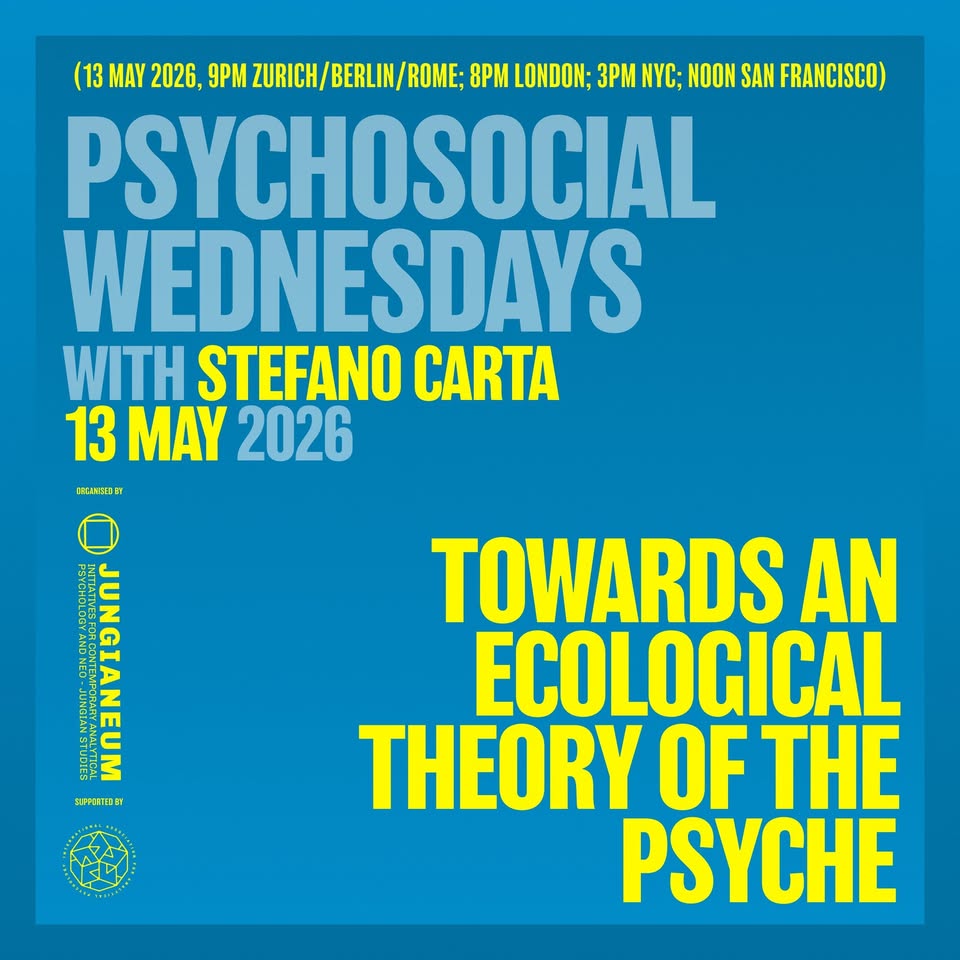
On May 13, 2026, at 8pm online, Stefano Carta joins Psychosocial Wednesdays with a lecture titled Towards an Ecological Theory of Mind. Carta proposes an ecological model of the psyche that traces the evolutionary roots of Jungian archetypes as functions-between rather than fixed inner forms — dynamic couplings of organism and environment, grounded in James Gibson’s theory of perception and action. From this perspective, archetypal images reflect not only the complexity of the mind but the structure of the ancestral environments from which they emerged. The Self, in this framework, is not a fixed centre but the dynamic entanglement of individual and world, a vision that aligns with predictive processing accounts of the psyche while remaining deeply Jungian at its core.
The IAAP Congress Paper
Those wanting a preview of Carta’s breadth as a thinker should seek out the paper and presentation he delivered at the 2025 IAAP Congress in Zurich, held to mark the 150th anniversary of Jung’s birth: Looking at Us Through Their Eyes: The Analytical Process from Ethnographic Perspectives. The paper has since been published in the Journal of Analytical Psychology.
It is a remarkable piece of work. Structured as a walk through a gallery of four rooms, it takes Freud’s concept of the uncanny as its starting point and inverts it — asking not what it feels like to see oneself as wholly Other, but what the analytic situation looks like when viewed through the eyes of Others entirely. Drawing on contemporary ethnographies from across Africa, Amazonia, Micronesia, and Siberia, Carta places Jungian clinical practice in dialogue with animist cosmologies, transgenerational rituals, performative language theory, and anthropological accounts of violence and the loss of ritual in modernity.
The clinical vignettes are extraordinary. A traumatised Italian woman whose transformative dream — in which an Indian woman in a sari tells her “I am your mother” — Carta reads not as metaphor but as ontological truth: the soul incarnated in the wrong world, in need not of interpretation but of a different context entirely. A Liberian refugee whose Djinns responded to nothing Western psychiatry could offer, until she was returned to the initiation ritual she had refused and recognised as the healer her lineage had always intended her to be. A woman whose paralysed Animus, traced across four generations, only released its grip on her thirteen-year-old daughter when the transgenerational spell at its root was finally named, something Carta suggests an African diviner would have addressed at birth.
The paper moves from these clinical scenes through John Austin’s distinction between constative and performative language — arguing that what makes analytic speech transformative is not its truth-value but its numinous, cosmogonic quality, the moment when saying something makes it real — to Victor Turner’s liminal anti-structure, and finally to a searing reading of American mass shooters as the symptomatic enactment of a society that has lost its ritual devices for transforming prey into hunter. It ends with a call for analysts to abandon Western psychotherapeutic exceptionalism and learn from what humanity has always known: that the analytical setting is the last living descendent of the rituals by which human beings have always tried to transform their prima materia into conscious, culturalised existence.
The congress recording can be accessed via the IAAP website here.
Stefano Carta is Full Professor of Dynamic Psychology and Ethno-Psychology at the University of Cagliari, Italy, a Jungian analyst who graduated from the C.G. Jung Institute in Küsnacht in 1992, and a former President of the Italian Association of Analytical Psychology (AIPA). He has been Visiting Professor at the University of Essex and Kyoto University, European Deputy Editor of the Journal of Analytical Psychology, and Editor-in-Chief of the Rivista di Psicologia Analitica, the oldest Italian Jungian journal. His two-volume work A Jungian and Evolutionary Approach to Psychology and Culture: The Infinite Ladder (Routledge, 2025) represents the most sustained development of his ecological and evolutionary model to date.