
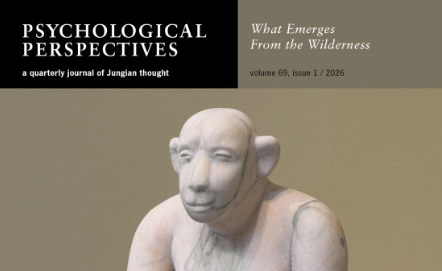
The latest issue of Psychological Perspectives, the journal of the C.G. Jung Institute of Los Angeles, arrives under the theme of: What Emerges From The Wilderness. It is a question that resonates across the natural world, the mythological imagination, and the interior life. The issue pursues it through an unusually wide range of registers, from neuroscience and trauma to fairy tales, ancient goddesses, and the American masculinity complex.
Nature, Soul, and Renewal
Several of the issue’s strongest pieces take the natural world as their literal and symbolic starting point. Tia Galipeau writes on the Giant Sequoia as her psyche’s taproot and protection against archetypal terror, an evocative pairing of the personal and the archetypal. Steven Galipeau’s piece on finding renewal after the fires speaks to a theme that has become urgently relevant across the American West, while sculptor Gwynn Murrill is profiled as the issue’s featured artist. Ryan J. Bush contributes a piece on his “Beyond” series, pointing toward what lies outside the ordinary, and Mike Diehl’s Starry-Eyed adds another contemplative note to this cluster of pieces on nature, wonder, and the limits of the known.
Myth, Fairy Tale, and the Archetypal Imagination
The issue is richly populated with mythological inquiry. Deborah Monninger explores helpful animals in fairy tales and dreams. Piotr Artysiewicz takes up the butterfly and phoenix as symbols of resurrection and the Self in the Jungian tradition. Human-Friedrich Unterrainer’s Deadly Embrace offers a reading of trauma and psychosis through the ambiguous lens of the Hades-Persephone myth. Amy C. Logan writes on becoming Demeter and Persephone in Sicily — ritual, the mother wound, and archetypal transformation in a landscape still saturated with these stories. Maria Zélia de Alvarenga brings the Ramayana into dialogue with analytical psychology, reading it as a symbolic account of the non-integration of the anima and its reflection in the depressive condition. And Sarko Gergerian’s Dionysus Rising! asks what the god of ecstasy, dissolution, and renewal might have to say to our current moment.
The Feminine, the Sacred, and the Political
Two pieces stand out for their engagement with the feminine and the sacred in a contemporary political key. Shoshana Fershtman asks whether recovering the Great Mother goddesses of ancient Israel and Palestine might help us find common ground. Benjamin S. Edwards turns his attention closer to home, exploring the ouroboric nature of America’s masculinity complex through the lens of family constellations work. Henry Lyne closes this section with Lucifer’s Shadow, a piece whose title alone suggests it will not be short of ambition.
Poetry: Louhi Pohjola
The issue’s featured poet is Louhi Pohjola (the pen name of Paula Stenberg) introduced by Naomi Lowinsky as the muse of indigenous mind. Her seven poems range from Finnish grandmother wisdom and Kalevala mythology to the Galápagos, Noah’s Ark, and the Norse goddess Idunn. They are accompanied by Lorna McNeur’s piece on active imagination and thinking hands, which bridges the poetry section and the visual art dimension of the issue.
Reviews
The issue closes with a book review of Diane Frank’s Mermaids and Musicians by Naomi Ruth Lowinsky, and a film review of Trần Anh Hùng’s The Taste of Things, a 2023 French film about love, cooking, and the passing of time, reviewed by Marybeth Carter.