
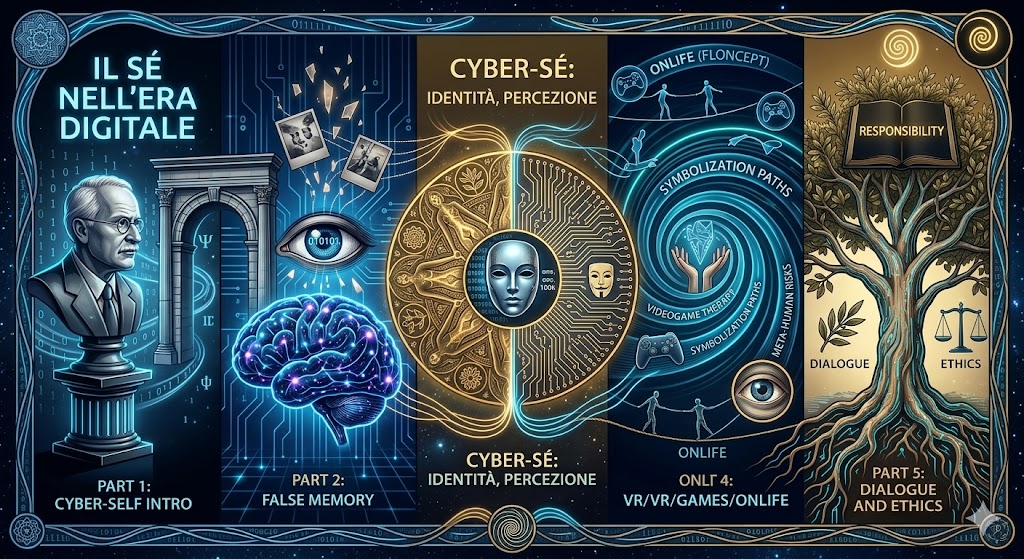
The Italian Association of Analytical Psychology (AIPA) has released a five-part video series examining one of the most urgent questions facing depth psychology today: what happens to the Self when intelligence becomes artificial? “The Self in the Digital Age – Cyber-Self: Identity, Perception, and Intelligent Technologies” brings together psychoanalyst Franco Castellana, architect and digital design expert Alessio Tomassetti, concept artist Luca Giarettino, and clinical psychologist Valerio Colangeli for a wide-ranging exploration of how digital technologies are fundamentally restructuring human consciousness, memory, and identity.
Conducted entirely in Italian, the series demonstrates the particular value of Jungian thinking when confronting technological transformation, recognising digital spaces not as mere tools but as places where the psyche’s collective nature becomes starkly visible. You can turn on automatically translated English subtitles on each video.
Part 1: Fluid Identity and the Psyche as Relational Space
The opening session establishes foundational perspectives on what the panelists call the “Cyber-Self.” Digital technologies, they argue, are making identity increasingly fluid while blurring boundaries between presence and absence, between internal psychological worlds and external digital realities. From a Jungian viewpoint, this fluidity isn’t entirely new, the Self has never been a fixed individual identity but rather an organising principle that operates relationally. What changes in the digital age is the arena where this relational nature plays out.
The discussion confronts uncomfortable truths about technology’s hidden costs: the massive energy and water consumption required to run render farms and process AI data, the environmental devastation, the geopolitical implications. Perhaps most psychologically significant is the devaluation of play. Traditional play functioned as a tool for personal growth and imagination; now it’s being colonized by marketing and gamification. The panel contrasts the “human-paced” imagination required for older, low-resolution games like Pac-Man with the hyper-realistic, passive consumption characterizing modern digital environments. Where earlier games demanded imaginative participation to fill in what pixels couldn’t show, contemporary technology provides finished images that may prevent the internal psychological work of meaning-making.
Part 2: Memory, False Memories, and the Contamination of Truth
The second segment addresses perhaps the most disturbing development: AI’s fundamental alteration of our relationship with memory and truth. The speakers discuss MIT research demonstrating that exposure to AI-altered images and videos increases false memory formation, with people often trusting these fabricated memories more than actual experience. Unlike traditional tools like Photoshop where manipulation remains visible and intentional, AI mediation operates invisibly and automatically, leading us to unconsciously delegate memory construction to algorithms.
The implications for historical consciousness are profound. The creation of fake historical photographs doesn’t just deceive; it pollutes historical archives, making it nearly impossible for ordinary people to distinguish synthetic information from authentic documentation. The panelists invoke Philip K. Dick’s Blade Runner, noting that we’ve reached the point where synthetic memories are no longer science fiction but biological and psychological reality. When the images we “remember” were never experienced, when the past itself becomes algorithmically generated, what happens to the foundation of identity, which depends fundamentally on continuity of memory?
Part 3: The Human-Machine Mirror and Life “Onlife”
Part three explores how we’re psychologically relating to AI systems in ways that reveal deep archetypal activation. People say “please” and “thank you” to ChatGPT, treating algorithms as if they possessed subjectivity. This isn’t mere politeness; it signals projection of the “other” onto the machine, activating relational patterns that evolved for human-to-human interaction. The question isn’t whether this is appropriate but what it reveals about how desperately we seek relationship, even with non-beings.
Drawing on Pirandello’s One, No One, and One Hundred Thousand, the panel examines digital masks, the personas we construct across social media platforms. We use these masks to hide or amplify aspects of ourselves, but risk losing control as identity fragments across the web. Adolescents face particular vulnerability because their identity is still forming; the digital environment pushes them toward performance-based existence where the social mask overrides authentic self-development.
Crucially, AI isn’t presented as neutral tool but as service designed to maximise engagement for profit, manipulating behavior through data collection. The philosopher Luciano Floridi’s concept of “Onlife” captures the contemporary reality: the boundary between offline and online has vanished. We inhabit continuous hybrid existence where digital and physical are no longer separable domains.
Part 4: Virtual Reality, Archetypal Risks, and the Colonization of Imagination
The fourth session acknowledges video games’ therapeutic potential. Games can function as laboratories for the Self, allowing players to explore different archetypal roles (warrior, mage, healer) and process emotions in protected space. This experimental dimension has genuine psychological value when consciously engaged.
However, the panel identifies a critical risk: the colonisation of imagination. When AI provides pre-packaged, fully rendered images, it may prevent the internal psychological process Jung called symbolisation, the slow gestation of meaning within the soul. Earlier technologies left gaps that imagination had to fill; contemporary technology fills every gap, potentially short-circuiting the very process through which psyche creates meaning from raw experience.
Advanced “Meta-Human” avatars now achieve visual indistinguishability from reality, enabling malicious uses from catfishing to fake news that appears completely authentic. The technological capacity to create perfect simulacra of human beings raises questions not just about deception but about what grounds our trust in perception itself when eyes can no longer reliably distinguish real from synthetic.
Part 5: Responsibility, Ethics, and Preserving the Human
The final segment functions as synthesizing dialogue on collective responsibility and possible paths forward. Technology, the panelists insist, is not neutral. While it could defeat disease or enhance human flourishing, current trajectories are driven primarily by corporate profit and social control mechanisms. We’ve created an educational gap of staggering proportions: nuclear-level power (smartphones, AI) has been distributed to a population that hasn’t been taught how to use it safely.
The speakers propose dialogue and awareness as what they call the “anticorp” against digital alienation, the antibody that might preserve human knowledge and the spark of individual choice in an increasingly automated world. They close with references to Italo Calvino and Pirandello, emphasizing that life remains a continuous flow that cannot be fully captured or concluded by any digital name or data point. The Self, in other words, exceeds every technological container even as it’s profoundly shaped by the digital environments we now inhabit.
The full five-part series is available on YouTube. For the broader international Jungian community, this work represents important contribution to ongoing dialogue about how analytical psychology addresses the genuinely unprecedented challenges posed by artificial intelligence, virtual reality, and the collapse of boundaries between digital and physical existence. The questions the series raises—Who are we while machines learn? What happens to identity when intelligence becomes artificial?—admit no simple answers, but Jungian thinking provides frameworks for asking them with appropriate depth and seriousness.