
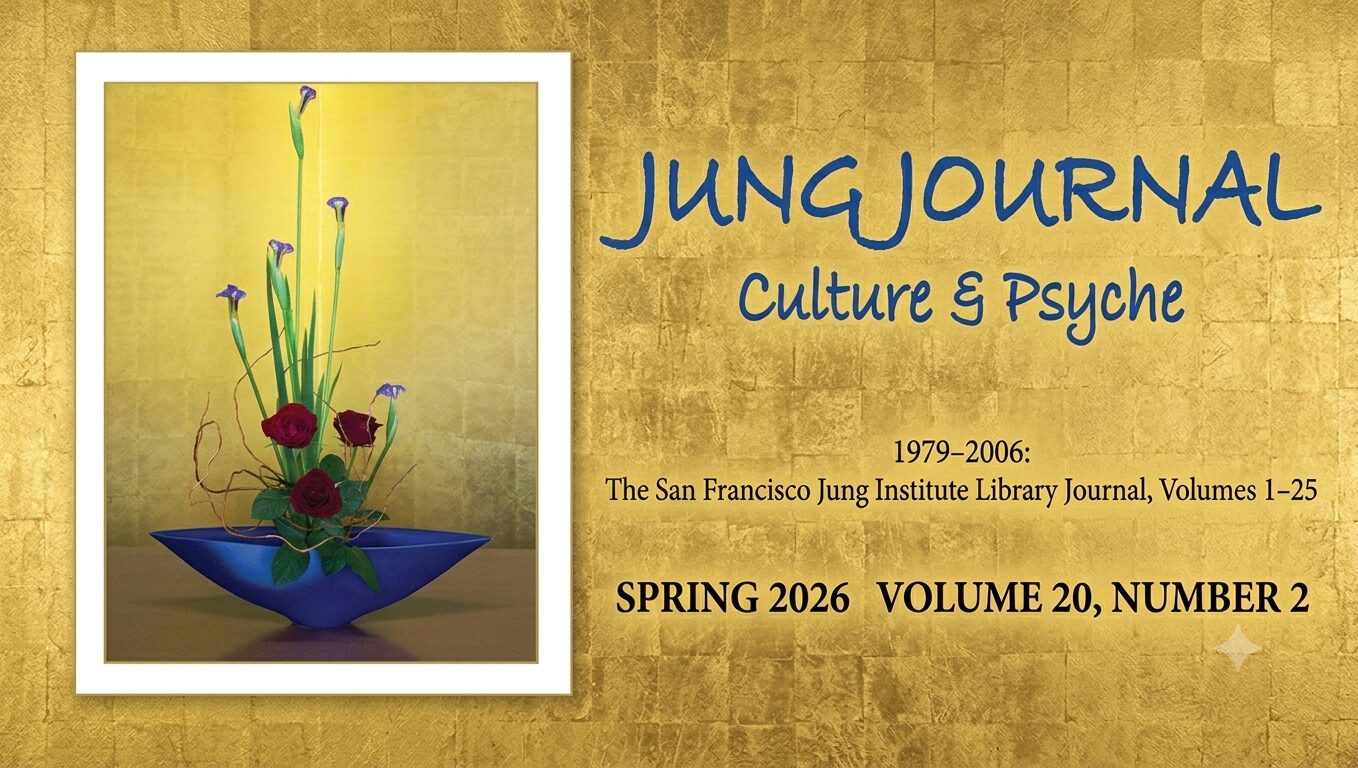
The second issue of the Jung Journal‘s twentieth volume arrives with a theme that weaves through almost every piece in it: creativity in its many forms, alongside darkness, redemption, and the archetypal imagination. It is a rich and varied issue, ranging from Shakespeare and opera to cave retreats for men, Persian miniature painting, and the psychology of Christmas. The issue also opens with six poems by Nick Lantz.
Free to Read: Creativity and the Art of Japanese Flower Arranging
The most-read piece in the issue and open access is Mara Alverson’s essay on Ikebana, the ancient Japanese art of flower arranging, as a portal into the creative process. Drawing on years of study with an Ikenobo Master Teacher at a Buddhist temple in California, Alverson traces the interplay between structure and freedom that lies at the heart of both Ikebana and the creative life more broadly. She finds in the Shoka form — its three lines representing Heaven, Earth, and Human — a structure that is a container, within which infinite variation becomes possible. The essay moves between the tactile pleasures of choosing and handling natural materials, the parallels with sonata form in music, and the sensation of being fully in one’s body that the practice brings. It is a beautiful essay about creativity written with heart. Read it free here.
Feature Essays and Review Articles
The issue opens with Eileen Cohune Brown’s feature essay Weaving Wholeness Through the Apocalypse, a story of resilience and recovery. Joel Crichton contributes the first part of The King of the End of the World, an archetypal reading of Shakespeare’s Henriad, a piece that will be familiar to those who caught his IAJS seminar that we featured last week on the same subject. Catrina Prager explores the fatal anima in opera and Romantic literature under the evocative title L’Enfer Sous Mes Pieds; Hell Beneath My Feet. Ben Ringler turns to a more clinical and mythological terrain with The Paradox of Caves: Helping Men Find Redemption in the Dark, the issue’s second most-read piece. And Xin Li examines the remarkable dialogue between Roman Catholic theology and Jungian psychology through the figure of Victor White, the Dominican priest whose friendship and correspondence with Jung remains one of the most fascinating and contested relationships in analytical psychology’s history.
In Film, Creativity, and the Archetypal Imagination
John Beebe contributes a brief film and video essay titled Nothing to Fall Back On. The Blocks and Mortar section gathers a cluster of pieces on creativity: a short essay on creativity itself, Alverson’s open access Ikebana piece, Kathleen Russ on handling pain through collage as a doorway to healing, and Rick Borutta on creativity through the lens of Samuel Beckett. D. Steven Nouriani occupies the ARAS section with a piece on Persian miniature paintings and the archetypal imagination, The Visionary Dimension, accompanied by what promises to be a visually rich PDF.
Reviews
The issue closes with Deborah Fausch’s review article On the Way to a Unity of Being, and a book review of Kendrick Lyddon Norris’s Jungian and Psychoanalytic Perspectives on Christmas, reviewed under the playful title Freud, Kohut, and Jung at the Manger by a trio of Vietnamese Jungian scholars.
The open access Ikebana essay can be read in full on the Jung Journal website. Remaining content is available via subscription or institutional access.