
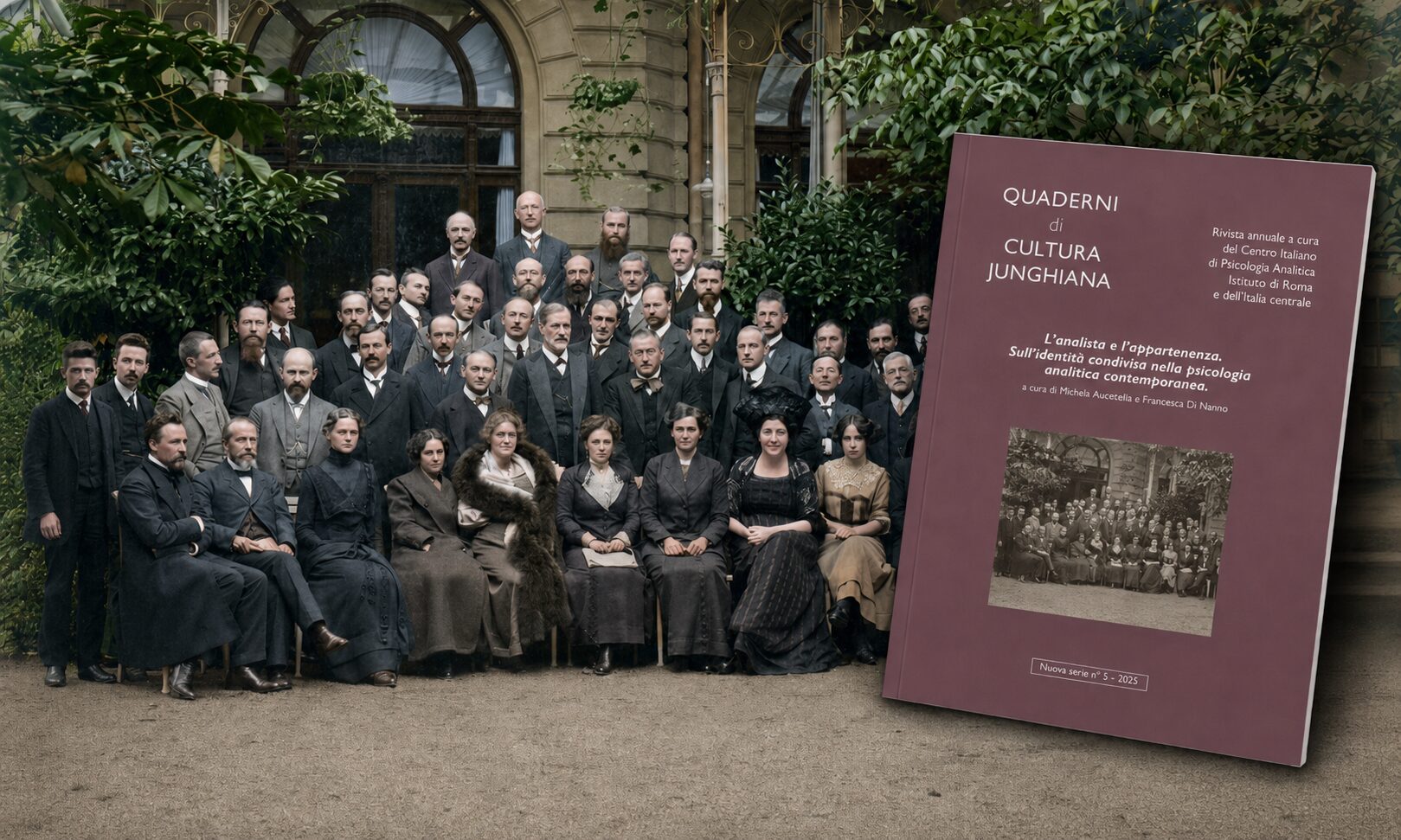
The latest issue of the Quaderni di Cultura Junghiana, published by CIPA – Istituto di Roma e dell’Italia Centrale, is built around a single theme: L’analista e l’appartenenza — “The Analyst and Belonging.” Editors Michele Accettella and Francesco Di Nuovo frame belonging not as a social label but as something psychic and primary — a tension between identity and otherness, rootedness and separation. The issue follows that tension from a candidate’s first interview all the way through to the analyst’s place in the wider community. The full journal, in Italian, is free to download at this link.
The centrepiece is a long three-way conversation, “Dibattito a tre,” between Francesco Di Nuovo, Fabrizio Alfani, Maria Ilena Marozza, and Robert M. Mercurio. It’s theoretical rather than clinical, and it covers a lot of ground: the difference between an “association” and a “community,” the archetypal pull of Apollo versus Eros in institutional life, how tradition survives change, and the particular shadow-side risks of Jungian institutes. It’s a rich read for anyone interested in the psychology of institutions themselves.
Vito Marino De Marinis follows with “Il senso di appartenenza e la cura del noi” (“The Sense of Belonging and the Care of the We”), a theoretical piece arguing that Jungian culture has always prized individuation over belonging — perhaps too much.
Two articles look directly at training. Ivan Di Marco and Francesco Marchini’s “Lettera a un futuro allievo” (“Letter to a Future Trainee”) is a warm, sometimes witty walk through the whole training journey, from selection interviews to final exams. Elena Gigante’s “Come si diventa terapeuti” (“How One Becomes a Therapist”) asks what a real trainee looks like, once we drop the fantasy of the ideal one — drawing on Bion, Winnicott, and even Carmelo Bene along the way.
For readers wanting clinical material, Felice David and Lucia Fani’s “Dal Centro Clinico alla polis” (“From the Clinical Centre to the Polis”) is the one to reach for. It discusses real casework from CIPA’s clinical centre, the use of the SWAP-200 diagnostic tool, and how cases get handed between colleagues.
Ivan Di Marco returns to close the theme with “La setta degli psicoanalisti” (“The Sect of the Psychoanalysts”) — a lively response to a newspaper’s cult accusations against psychoanalysis, tracing the idea back to Freud’s secret committee and Otto Rank’s writing on the double.
There’s also a strong visual thread running through the issue, pairing Matisse, Seurat, and Botero with photographs of Jung’s carved stone at Bollingen. And the closing “Libri, film e…” section offers two shorter reviews: Angiola Iapoce on Gigante and Romano’s Scritture della cura, and Giuseppe M. Vadalà on Tarkovsky’s Andréj Rublëv.
The Quaderni di Cultura Junghiana is the annual online review of CIPA – Istituto di Roma e dell’Italia Centrale, founded in 2012 to showcase the Institute’s work and give trainees a place to publish. It’s freely available at quadernidiculturajunghiana.it, so this whole issue is just a click away. The Jungian Directory thanks the editorial team, led by Gianfranco D’Ingegno and Angiola Iapoce, for making it so easy to share.