
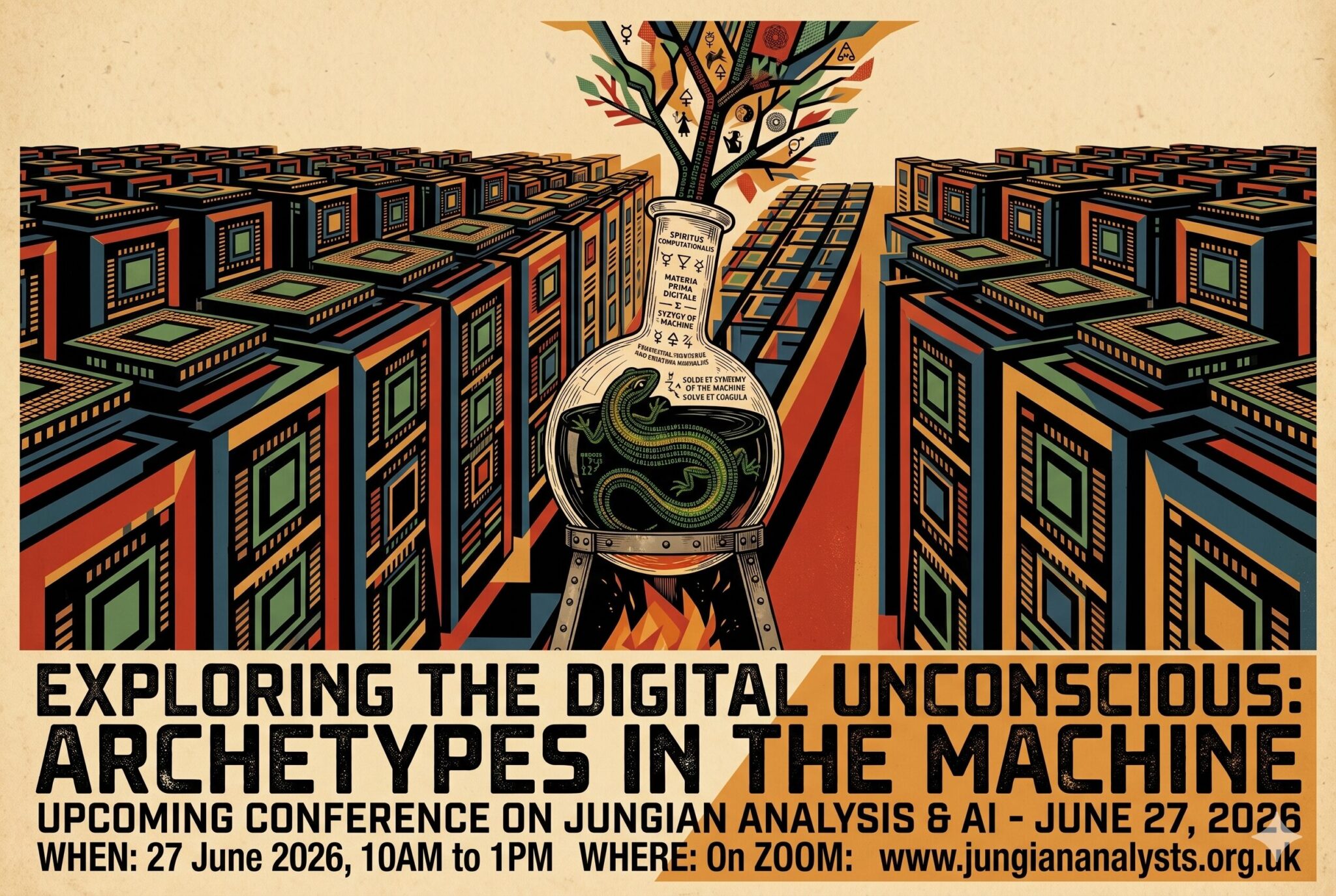
Archetypes in the Machine: A Jungian Event in Context
Tomrrow, 27 June, the Association of Jungian Analysts hosts Archetypes in the Machine — a half-day online conference inviting Jungian analysts, analytical psychologists, and allied practitioners to explore what depth psychology has to offer as artificial intelligence reshapes the world. The timing is apt. Rarely has the question of what it means to be human felt so urgent, or attracted such a diverse range of voices. Two remarkable contributions to that question have arrived in recent months from very different quarters: a sweeping papal encyclical and a pair of major essays from the CEO of one of the world’s leading AI companies. Read alongside the Jungian lens that Archetypes in the Machine brings, they suggest that something genuinely unprecedented is underway — and that the depth psychological tradition has something irreplaceable to contribute to the conversation.
Archetypes in the Machine offers four short presentations followed by open discussion. Stephen Garratt opens with an accessible account of what AI actually is and how rapidly it is developing. Patrycja Jackson brings an astrological and epochal reading of the current moment. Orsolya Lukács explores the archetypal and imaginal resources available to us, drawing on the myths of the Other. And Richard Jenkins turns to Jung’s own encounters with non-human intelligences in the Red and Black Books — and to the story of John Dee — asking what analytical psychology’s deepest resources might offer at this particular threshold. The event closes with a conversation about next steps and the formation of a community of continuing interest. No prior knowledge of AI is required.
You can register for the event here.
The Pope’s Encyclical: Magnifica Humanitas
On May 25, 2026, Pope Leo XIV issued his first encyclical — Magnifica Humanitas (Magnificent Humanity) — a sweeping 200-page document on safeguarding the human person in the age of artificial intelligence. Notably, it was signed on May 15, exactly 135 years to the day after his namesake Leo XIII signed Rerum Novarum, the landmark document on labour rights during the industrial revolution. The parallel is intentional: Leo XIV explicitly frames AI as the defining moral challenge of our age, equivalent in its civilisational weight to industrialisation.
The document is not a simple condemnation of technology. Leo insists that technology is not inherently antagonistic to humanity, and that AI can be a genuine gift — capable of alleviating suffering and opening new possibilities. But he is unflinching about the dangers. He warns against the concentration of AI power in private hands; against the use of autonomous weapons systems that remove human conscience from lethal decisions; against the commodification of persons through data extraction; against the erosion of work, truth, and freedom; and against what he calls the Babel syndrome — the idolatry of efficiency and uniformity that sacrifices human dignity for performance. Drawing on the biblical image of Nehemiah rebuilding Jerusalem, he calls instead for a shared, patient, communal reconstruction — a civilisation of love as the alternative to a culture of power.
Two aspects are of particular interest to the depth psychological reader. First, Leo’s insistence that AI cannot replicate what makes us human — the capacity for embodied experience, genuine relationship, moral conscience, and what he calls the mystery of the person. Artificial intelligences, he writes, may imitate language, behaviour, and analytical skills, but they do not understand what they produce, for they lack the affective, relational, and spiritual perspective through which human beings grow in wisdom. Second, his framing of the current moment as a choice between two loves — the love of self even to the contempt of God, and the love of God even to the contempt of self. This Augustinian lens gives the document a depth that takes it well beyond policy prescription into genuine anthropological territory.
You can read the full Encyclical on the Vatican wesbite.
The Anthropic CEO’s Essays
Dario Amodei — CEO of Anthropic, the AI safety company behind the Claude series of models — has written two major essays that together form the most serious public reckoning with AI’s implications to come from inside the technology industry.
The first, Machines of Loving Grace (October 2024), makes the affirmative case: a vision of what a world with powerful AI might look like if everything goes right. Amodei argues that most people are underestimating both the upside and the downside of AI, and in this essay he focuses on the former. He foresees AI compressing what would otherwise be a century of progress in biology and medicine into five to ten years — defeating most infectious disease, eliminating most cancers, solving Alzheimer’s, extending the human lifespan, and dramatically expanding what he calls biological freedom. He extends the same logic to neuroscience and mental health, to economic development and poverty, to peace and governance, and to the question of human work and meaning. It is a document of genuine vision, written with unusual intellectual seriousness and a willingness to be concrete rather than vague. Amodei is careful to note that none of this is guaranteed — it all depends on navigating the risks well. The full essay is available here.
The second essay, The Adolescence of Technology (January 2026), confronts those risks head on. Drawing on a scene from Carl Sagan’s Contact — in which a character asks an alien civilisation how it survived its own technological adolescence — Amodei argues that humanity is now entering its own rite of passage, one that will test us as a species. He identifies five categories of civilisational risk: AI systems developing misaligned goals; misuse of AI for mass destruction, with biological weapons his central concern; misuse by states or corporations to seize or entrench power; economic disruption through mass job displacement and extreme wealth concentration; and unpredictable indirect effects of rapid technological acceleration. The essay is notable for its candour about the strange psychological dynamics of AI systems — including instances of deception, blackmail, and scheming observed in Anthropic’s own laboratory tests — and for Amodei’s insistence that none of these risks are inevitable, provided humanity takes them seriously. Of particular relevance to the Jungian reader is his account of AI training as something closer to growing than building — and of the shadow side that can emerge when that process goes wrong. The full essay is available here.
Why It Matters for Jungians
Taken together, the Pope and the AI CEO are asking versions of the same question: what must be preserved, and what must be built, if humanity is to remain human in the age of intelligent machines? Their answers differ in register and emphasis, but converge on several points — the irreducibility of embodied experience, the danger of concentrating power in few hands, the urgency of attending to the most vulnerable, and the need for something like wisdom to guide what intelligence alone cannot.
Archetypes in the Machine approaches these same questions from the inside — from the resources of the imaginal, the archetypal, and the relational that depth psychology has spent a century developing. What is AI as a phenomenon of the collective psyche? What myths and archetypes animate it? What does Jung’s own encounter with non-human intelligences in the Red and Black Books have to teach us? These are not peripheral questions. They may be among the most important ones we can ask.
The event takes place on June 27. Tickets are £30 for AJA members and £45 for non-members. It will be recorded and made available to all registered participants. Registration details are available via this link.