
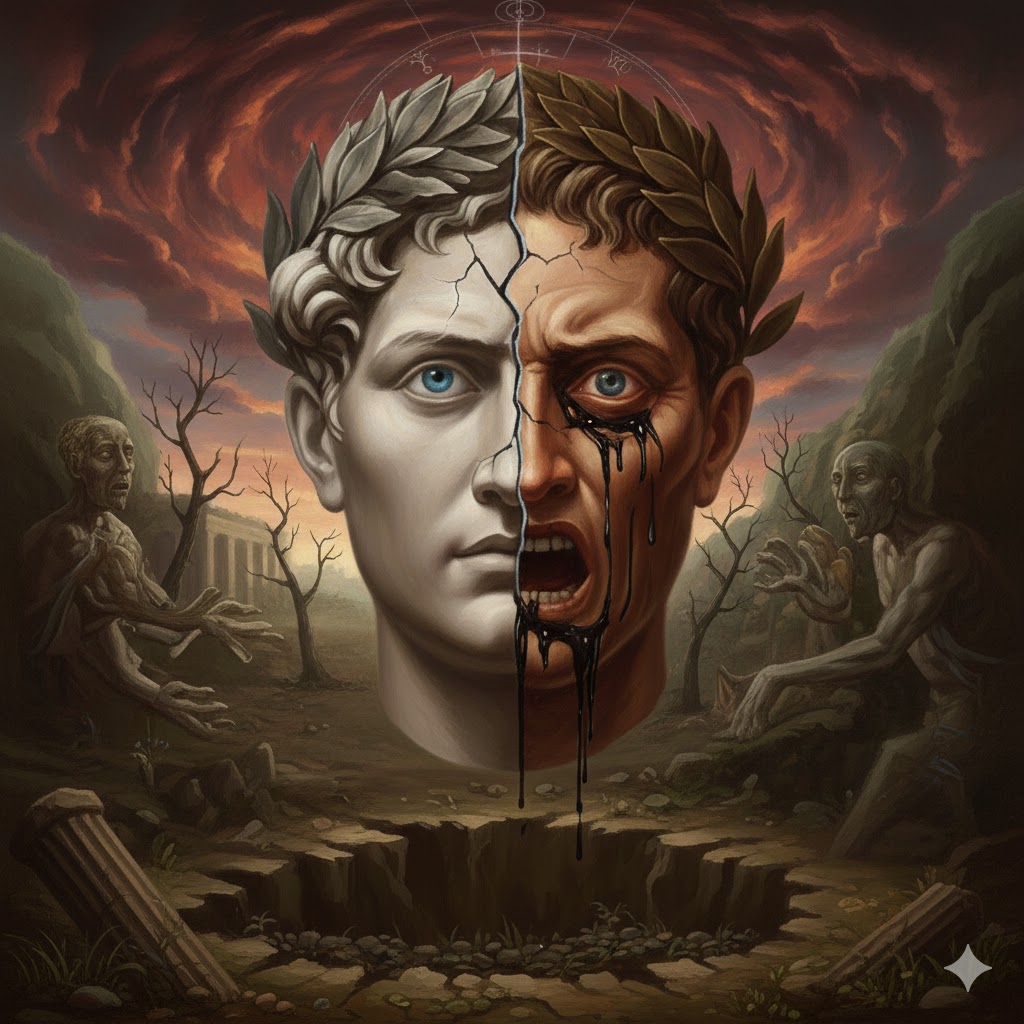
What makes a strength become a fatal flaw? In a newly published open-access article in the Journal of Analytical Psychology, Sofie Qwarnström explores how Jung’s concept of psychological “one-sidedness” mirrors the fundamental structure of Shakespearean tragedy.
The Paradox of Crippling Strength
Both Jung and Shakespeare, Qwarnström argues, understood that tragedy stems not from simple weakness but from virtues pushed to destructive extremes. Jung proposed that as individuals develop, they inevitably specialize in certain psychological functions—becoming adept at thinking or feeling, sensing or intuiting—while the opposite “inferior” function remains underdeveloped and outside conscious control. This creates dangerous imbalance: “You achieve balance only if you nurture your opposite,” Jung wrote, “But that is hateful to you in your innermost core, because it is not heroic.”
Shakespeare’s tragedies follow precisely this pattern. Literary critic A.C. Bradley observed that Shakespeare’s protagonists are brought low by a “marked one-sidedness”—a fatal tendency to identify their entire being with a single quality. The article traces this back to the classical concept of hubris, which ancient Greeks understood not as arrogance but as a kind of “virtue gone mad”—like a plant suffering from excessive nurture that must be pruned. The robust health of one dimension, if unbalanced, becomes aberrant and self-destructive.
Two Mirrors: Coriolanus and Timon
Qwarnström’s analysis centers on two of Shakespeare’s lesser-known plays, Coriolanus and Timon of Athens, which present mirror-image tragedies. Both plays open with the same symbolic motif—a hungry crowd—but the protagonists respond in opposite ways.
Coriolanus embodies what Jung called Introverted Thinking with inferior Extraverted Feeling. A legendary Roman soldier but disastrous politician, Coriolanus is committed to abstract principles of merit and justice while utterly tone-deaf to the emotional needs of the Roman people. He withholds nourishment (both literal grain and emotional connection) from the starving plebeians, whom he views as an unpredictable mob of “slaves” to their passions. His fear of emotional influence is so intense that he barricades himself behind rigid principles, eventually leading to his banishment and death.
Timon of Athens represents the opposite extreme: Extraverted Feeling with inferior Introverted Thinking. Timon bankrupts himself through extravagant generosity, throwing lavish feasts for all of Athens while ignoring the cynical philosopher Apemantus, who warns him that his “friends” are mercenaries. When betrayed, the heartbroken Timon flips to the opposite extreme—cursing all humanity and dying in misanthropic isolation.
The Hunger Metaphor
The article’s most compelling insight concerns Shakespeare’s symbolic linking of eating with psychological function. Coriolanus starves his people both literally (withholding grain) and emotionally (withholding connection), mirroring how an overdeveloped superior function starves the inferior. His superior function, like a tyrant hoarding resources, refuses to “sacrifice” any strength to nourish its opposite.
Timon, conversely, feeds everyone indiscriminately until he himself is “eaten” by parasitic flatterers—exactly what Coriolanus fears would happen if he relaxed his rigid boundaries. Where Coriolanus is “like a dam, holding back immense pressure and causing drought,” Timon is “wide open and left with nothing.”
Enantiodromia: When Opposites Flip
Both plays illustrate Jung’s concept of enantiodromia—the principle that everything eventually transforms into its opposite when taken to an extreme. The ignored inferior function doesn’t simply remain dormant; it builds pressure proportional to its repression until it erupts catastrophically. Coriolanus, the principled stoic, becomes capable of destroying Rome itself when his emotions finally overwhelm him. Timon, the generous philanthropist, becomes a misanthropic hermit cursing all mankind.
Qwarnström includes striking visual representations of Jung’s eight-function model using an armillary sphere—showing how consciousness illuminates certain functions while leaving others in shadow, and how sustained one-sidedness creates unsustainable psychological tension.
The Inferior Function as Mob
Perhaps the article’s most innovative move is reading the angry plebeians in Coriolanus and the cynical Apemantus in Timon as external representations of each protagonist’s repressed inferior function. The starving, mutinous mob that Coriolanus despises represents his own unconscious hunger for emotional connection. Apemantus, the “dog-like” cynic whom Timon silences, embodies the critical, measuring Introverted Thinking that Timon refuses to consult.
Contemporary Relevance
Qwarnström concludes with Jung’s warning that our most urgent priority is not perfecting our technical mastery over nature, but examining the character of those who wield power. On a personal scale, one-sidedness fuels cycles of judgment, tunnel vision, and condemnation. On a national scale, it becomes catastrophic. By projecting our repressed traits onto others, we see our hatred not as weakness but as justified reaction to evil, allowing ourselves to dehumanize opposing views.
The article demonstrates how Jung’s typology and Shakespeare’s drama both reveal a fundamental psychological truth: genuine strength requires integration of opposites. It is useless to have independent principles without considering communal harmony, just as it is worthless to pursue harmony without the anchor of principles. The tragedy is not that we develop strengths, but that we mistake partial development for completeness.
Citation: Qwarnström, S. (2026). One-Sidedness and the Inferior Function in Coriolanus and Timon of Athens. Journal of Analytical Psychology, https://doi.org/10.1111/1468-5922.70023
This article is published open-access and available to read in full.