
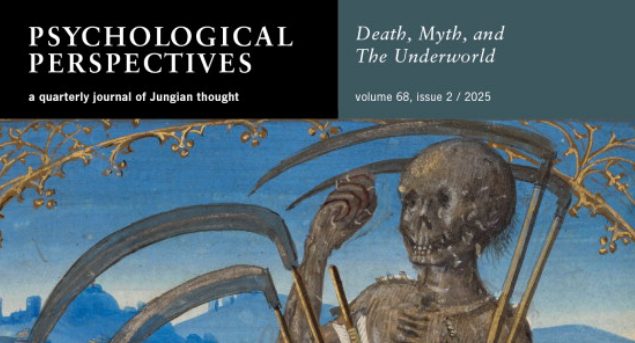
The latest issue of Psychological Perspectives, now in it’s 55th year of publishing, centers around the theme “Death, Myth, and the Underworld,” introduced by Pamela Freundl Kirst, who provides the contextual framework for exploring archetypal themes of mortality and transformation in her open-access piece.
The issue opens with Nancy Mozur’s About the Art: Skulls and Bones, which examines the symbolic significance of death imagery in artistic expression. Raïna Manuel-Paris follows with War, Wisdom, and Wonder: Understanding the Role of the Feminine Principle in War, exploring how feminine archetypal energies manifest and function within the context of conflict and warfare. Barbara Platek contributes The Soul’s Round Form: Encountering Mandala Symbolism, investigating the psychological and spiritual significance of circular sacred symbols in individuation processes.
Jacques D. P. Labello presents Facing the Nemean Lion: A Herculean Task of Individuation, which uses the mythological framework of Hercules’ labors to examine personal transformation and the hero’s journey in psychological development. Rachel Taylor’s From Maiden to Seductress: An Archetypal Analysis of Female Development and Self-Objectification analyzes contemporary issues of feminine identity formation and the psychological dynamics underlying self-objectification in modern culture. Robert Strayer offers Carl Jung: Engaging with History,” which examines Jung’s relationship with historical events and his approach to understanding collective psychological phenomena.
Peggy Vermeesch contributes a fascinating cultural analysis with Star Trek’s New Borg: Transformation of the Collective Shadow According to Neumann’s ‘New Ethic,’ demonstrating how popular science fiction can illuminate psychological concepts about collective shadow work and ethical transformation. Stephen K. Witty provides a deeply personal exploration in When I Was Dying: Toward a Phenomenology of the Experience of Facing Death, offering insights into the psychological dimensions of near-death experiences and mortality awareness.
Charles G. Zimbrick-Rogers presents Of Fire, Tears, Hair, and Gold: ‘The Devil’s Sooty Brother’ and the Redemption of the Dark Side of God, which analyzes a Grimm fairy tale through the lens of Jungian thought to explore themes of divine darkness and psychological redemption. Carolyn Mikulencak contributes two pieces: Orpheus in Oklahoma: On Muses, Distance, and Art, which examines the creative process and artistic inspiration through mythological frameworks, and Like an Old Testament God: The Self and Death, exploring the relationship between the archetypal Self and mortality.
The issue also features an interview section with Robert Henderson’s Midwife to the Unconscious: An ‘Enterview’ with Attracta Fahy, providing insights into contemporary analytical practice. The poetry section includes works by Nidhi Agrawal with Absence x Presence, X-Ray, and Confluence, as well as Richard Parra’s People of Yemen, demonstrating the journal’s commitment to creative expression alongside scholarly analysis. Book reviews cover recent publications including Robert Tyminski’s work on immigration psychology reviewed by Natalia El-Sheikh, Aniela Jaffé’s reflections on Jung’s life and dreams reviewed by Isabelle DeArmond, and an archival collection from the C.G. Jung Institute Zürich reviewed by Barbara Platek. The issue concludes with Dragana Favre’s film review of “Previously Saved Version” directed by Kei Ishikawa.
You can see the full list of articles here.