
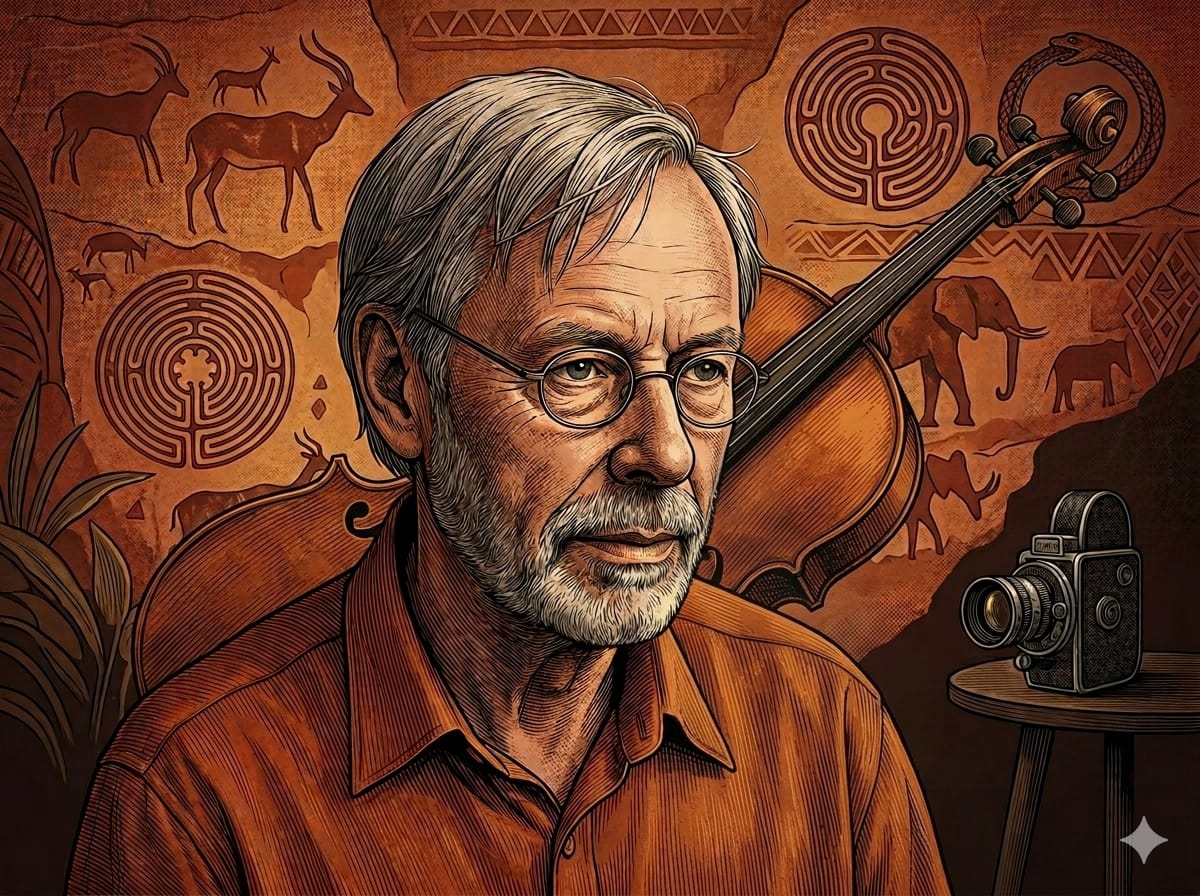
The International School of Analytical Psychology Zurich has assembled a remarkable tribute for Peter Ammann’s 95th birthday: a comprehensive digital collection spanning over five decades of filmmaking, lecturing, and bridge-building between Jungian psychology and African traditional healing. The Peter Ammann Collection makes available documentary films and lectures that trace an extraordinary journey from a crucial 1956 visit with the 80-year-old C.G. Jung to ongoing dialogue work with South African traditional healers.
Ammann’s path defies conventional categorisation. Initially trained as a cellist in Zürich and Paris, his encounter with Jung redirected him toward analytical psychology, where he trained with Jolande Jacobi and Marie-Louise von Franz, graduating from the C.G. Jung-Institute Zurich in 1965 while simultaneously earning a doctorate in musicology, history of religion, and ethnology. His passion for filmmaking then led him to Rome, where he apprenticed with Federico Fellini during the production of Satyricon—an experience he revisits in a 2022 lecture exploring how Fellini’s dreams guided him from personal narrative toward archetypal themes during creative crisis.
Documenting the Margins
Working as independent filmmaker and collaborating with Swiss Television since 1970, Ammann’s early documentaries addressed immigration and exclusion. The Red Train and the Myth of William Tell (1972/2025) follows Italian workers traveling from Switzerland to vote in Italy, exposing contradictions beneath Switzerland’s national liberation myth—William Tell remaining folkloric figure for many Swiss but symbol of hope for freedom from unbearable conditions for Italian emigrants. This attention to those relegated to society’s margins would find deeper expression through his African work.
Africa: Restoration and Dialogue
A 1984 encounter with Laurens van der Post sparked Ammann’s enduring engagement with Africa. The collection includes Spirits of the Rocks (2002), exploring what touches us deeply about the Bushpeople (San) through their extraordinary rock paintings, restoring links with ancestral hunter-gatherer consciousness. Mabi’s Feast (2014) documents a traditional Zulu healer’s first meeting with the San people who had appeared in his dreams teaching him everything about healing. Hlonipa – Journey Into Wilderness (1992), introduced by van der Post, shows how wilderness trail transforms from outer adventure into inner experience as participants recount dreams and meditations.
Ammann’s lectures demonstrate sustained theoretical engagement with these experiences. Rock Art & the Origin of Consciousness (2023) explores how rock paintings reveal humanity’s emergence as symbolic species seeking consciousness through symbol-making. Listening to the Unconscious – Listening to the Ancestors (2023) argues that Jungian psychology’s closeness to African psychology stems from Jung’s concepts being grounded in how humans have experienced psychic life across cultures since immemorial times, not theoretical constructs.
Pioneering Dialogue
Since 2016, Ammann has co-facilitated dialogue between South African Jungian analysts and African Traditional Health Practitioners alongside Nomfundo Mlisa, Renee Ramsden, and colleagues. This groundbreaking work, presented at the 2019 IAAP Congress in Vienna and documented on film, explores intersections between analytical psychology and traditional healing, addressing similarities, differences, the role of ancestors, and potential for ongoing exchange. The collection includes Healing in Two Worlds (2008) from the 2007 Cape Town IAAP Congress and interview with Vera Bührmann, first Jungian analyst in South Africa whose book Living in Two Worlds remains foundational text.
Preserving Living Encounters
The collection also preserves intimate encounters with analytical psychology’s founders. Ammann’s A Visit to Jung – Revisited (2021) recounts conversations with Jung on dreams and music, revealing someone “very human, not pretending to know everything, and at times vulnerable and embittered by not being taken seriously.” The 1982 film with Marie-Louise von Franz provides her insights on collaboration with Jung, dream interpretation, creativity, synchronicity, and alchemy. The classic 1972 documentary with Dora M. Kalff remains the only film showing her sandplay method.
As Deborah Egger notes in her intriduction, this collection demonstrates “a living relationship, an inner dialogue, between ego and the unconscious, personal and collective”—precisely what characterises Ammann’s remarkable 95-year journey.